Fire Damage Restoration in Beaverton, OR — Complete Fire & Smoke Cleanup for Your Home and Business
Same/Next-Day Fire Damage Restoration in Beaverton — Serving Central Beaverton · Five Oaks · Sexton Mountain · Greenway · West Slope · South Beaverton · Vose · Highland · Neighbors Southwest Since 2015
If your home or property has been damaged by fire, smoke, soot, or the water left behind by firefighting efforts, Fanno Beaver Restoration provides fast, certified fire damage restoration in Beaverton, Oregon. Our 30-person IICRC-certified team specializes in complete fire and smoke damage cleanup, structural drying, soot removal, odor elimination, and full property reconstruction — using Fire and Smoke Damage Restoration Technician (FSRT) certified methods and industry-approved equipment so your Beaverton home or business is genuinely safe, thoroughly clean, and fully restored after any fire loss event. We respond 24 hours a day, 7 days a week, 365 days a year because fire damage never waits for business hours.
- Local Beaverton, OR fire damage restoration contractor serving Washington County since 2015
- FSRT, WRT, ASD, AMRT & CDS certified — full IICRC-credentialed fire restoration team
- 24/7 emergency response for active fire losses, smoke damage, structural hazards, and insurance documentation
- Direct insurance coordination with Servpro, ServiceMaster Restore, 911 Restoration, Paul Davis & more
24/7 Emergency Fire Damage Restoration — We Answer Every Call, Every Hour
Request Emergency Fire Damage Service
Fill out the form below and we'll contact you immediately!
Award-Winning Fire Damage Restoration in Beaverton, OR — Certified, Experienced & Insurance-Ready
Top-rated fire and smoke damage restoration team serving the Tualatin Valley Region and all of Washington County
Fanno Beaver Restoration is a fully certified fire damage restoration contractor with 10+ years of hands-on experience restoring fire and smoke-damaged homes and commercial properties throughout Beaverton, Washington County, and the greater Tualatin Valley Region. Recognized by Servpro, ServiceMaster Restore, and Restoration 1 as a top regional restoration provider — and awarded Best Air Quality & Restoration and Flood Department and Compassion Clean Regional Specialist designations — we deliver code-compliant, insurance-grade fire damage restoration that protects your property value, preserves your coverage outcomes, and returns your home to safe, livable condition as quickly as possible. Our 30-person team and 5 fully equipped service vans mean we have the capacity to respond immediately and complete your restoration without subcontracting critical work to unknown crews.
Fire Damage Restoration for Homes & Businesses Near Beaverton Landmarks, Parks & Community Areas
From the historic Belle Ainsworth Jenkins Estate and Patricia Reser Center for the Arts to Nike World Headquarters, Progress Ridge TownSquare, and Fanno Creek Greenway
Fanno Beaver Restoration responds to fire damage emergencies throughout Beaverton, Oregon — from historic properties near the Belle Ainsworth Jenkins Estate and the Historic Jenkins Estate (THPRD) to modern neighborhoods surrounding Nike World Headquarters, the Patricia Reser Center for the Arts, and Progress Ridge TownSquare. Beaverton's unique urban-wildland interface, with dense residential neighborhoods immediately adjacent to Tualatin Hills Nature Park, Cooper Mountain Nature Park, Fanno Creek Greenway, and Hyland Forest Park, creates genuine wildfire ember exposure risk for homes across the city — particularly in communities like West Slope, Sexton Mountain, Five Oaks, and Neighbors Southwest. At the same time, older residential construction in Central Beaverton, Vose, and Denney Whitford carries elevated electrical fire and kitchen fire risk due to aging wiring and original construction materials. Whether your fire loss occurs near a community landmark, a greenway corridor, or a busy commercial district, Fanno Beaver Restoration's local team is equipped and ready to respond immediately with certified fire damage restoration in Beaverton, OR.
Beaverton Neighborhoods & Communities Served
- Central Beaverton
- Denney Whitford / Raleigh West
- Five Oaks / Triple Creek
- Greenway
- Highland
- Neighbors Southwest
- Sexton Mountain
- South Beaverton
- Vose
- West Beaverton
- West Slope
Historic & Cultural Landmarks Near Our Service Area
- Belle Ainsworth Jenkins Estate
- Historic Jenkins Estate (THPRD)
- Patricia Reser Center for the Arts (The Reser)
- The Round at Beaverton Central
- Icarus at Kittyhawk — Beaverton Central MAX Station
- Three Creeks One Will — The Round South Plaza
- Beaverton Historical Society
Nature Parks & Recreation Areas
- Tualatin Hills Nature Park
- Tualatin Hills Nature Center
- Cooper Mountain Nature Park
- Fanno Creek Greenway / Fanno Creek Trail
- Hyland Forest Park / Hyland Woods Natural Area
- Magnolia Park · Cedar Hills Park
- Hidden Creek Park · Mountain View Champions Park
- Vista Brook Park · Evelyn M. Schiffer Memorial Park
- Barsotti Park · Tualatin Hills P&R District
- Beaverton Swim Center · Aloha Swim Center
- Millikan Way Nature Trail
Shopping, Dining & Community Hubs
- Beaverton Farmers Market
- Beaverton Winter Farmers Market
- Progress Ridge TownSquare
- Cedar Hills Crossing
- BG's Food Cartel food cart pod
- Beaverton City Library
- Beaverton City Hall / The Round area
- Downtown Beaverton District
- Cooper Mountain Vineyards
- Nike World Headquarters
Nearby Portland-Area Destinations
- Washington Park · Oregon Zoo
- Portland Japanese Garden
- International Rose Test Garden
- Hoyt Arboretum
- World Forestry Center Discovery Museum
- Pittock Mansion
- Forest Park — Wildwood & Lower Macleay Trail
- Tom McCall Waterfront Park
- Powell's City of Books · Portland Art Museum
- Lan Su Chinese Garden · OMSI
Nearby Service Area Cities — We Also Serve
Beaverton's Fire Damage Restoration Specialists — Not a General Cleanup Crew or Paint-Over Contractor
Full fire, smoke, soot, odor, and structural restoration — certified, documented, and done completely right
At Fanno Beaver Restoration, we focus exclusively on certified fire damage restoration and smoke cleanup — not surface-level paint-and-patch jobs or generic cleaning crews that mask damage without genuinely fixing it. Our FSRT-certified crews perform complete structural fire assessments, smoke penetration evaluations, soot removal at every layer of your property, molecular-level odor neutralization, and full reconstruction using IICRC-approved methods and equipment. We do not spray air freshener over smoke odor, paint over soot stains, or hand your file to a subcontractor. Whether your Beaverton home suffered a kitchen fire in Central Beaverton, an electrical fire in West Slope, or wildfire ember damage in Sexton Mountain or Five Oaks, we design a complete, certified fire damage restoration plan so your property is genuinely safe — verified by air quality testing and documented for your insurance carrier — not just superficially clean.
- Dedicated FSRT-certified fire and smoke damage restoration crews — in-house, not subcontracted
- Restoration systems built for Beaverton's specific climate, construction types, and urban-wildland fire exposure patterns
- Clear guidance on surface smoke cleanup vs partial restoration vs complete structural fire damage reconstruction
- Detailed photo documentation and written scope reports for insurance claims, adjuster review, and property resale
- Smoke odor elimination using thermal fogging, hydroxyl generators, and ozone treatment — not masking agents
- Complete insurance coordination from first call through final claim settlement — we work directly with your carrier
- Air quality testing and certified occupancy clearance documentation — your family doesn't return until it's proven safe
When Do Beaverton, OR Homeowners and Property Owners Need Professional Fire Damage Restoration?
The visible signs of fire and smoke damage are almost always just the beginning of the real problem
After a fire — even one that appears minor or contained — the damage visible to the naked eye is rarely the complete picture of what has actually occurred inside your property. Smoke, soot, and heat penetrate wall cavities, insulation, HVAC ductwork, and structural framing in ways that no surface cleaning product or general contractor can adequately reach or address. In Beaverton, where homes range from older wood-frame construction in Central Beaverton, Vose, and Denney Whitford to newer developments in Sexton Mountain, Five Oaks, and Neighbors Southwest — and where the wet-dry seasonal cycle creates a perfect environment for post-fire mold growth — fire damage hidden inside walls, attic spaces, and mechanical systems can lead to structural compromise, persistent toxic odor, and serious air quality hazards that escalate dramatically when professional certified fire damage restoration in Beaverton, OR is delayed even by a few days.
Visible soot, char, or burn marks on walls, ceilings, structural framing, or attic materials
Persistent smoke odor that lingers or intensifies even after opening windows and ventilating the property
Discoloration, yellowing, greasy residue, or black film on surfaces beyond the fire origin room
Water damage, wet insulation, or saturated drywall from firefighting hose lines or sprinkler activation
HVAC system was running during or after the fire — smoke has been distributed throughout the entire property
Structural components including framing, floor joists, rafters, or subfloor exposed to direct flame or intense radiant heat
Electrical outlets, panels, junction boxes, or wiring showing heat exposure, scorch marks, or visible burn damage
Melted plastic, synthetic materials, or chemical storage items involved in the fire — requiring specialized toxic residue cleanup
Who Our Fire Damage Restoration Service in Beaverton, OR Is Designed to Serve
Homeowners, landlords, investors, small business owners, and property managers with fire or smoke-damaged properties in Beaverton and Washington County
Fanno Beaver Restoration provides complete, certified fire damage restoration for residential properties, rental homes, and small commercial buildings throughout Beaverton, Oregon and all of Washington County — from neighborhoods adjacent to Fanno Creek Trail and Tualatin Hills Nature Park to commercial corridors near Cedar Hills Crossing, Progress Ridge TownSquare, and Downtown Beaverton. Regardless of how the fire started, how large or small the damage appears, or where your property is located in the Beaverton area, our 30-person certified team is equipped to respond immediately and restore your property to safe, verified occupancy condition.
Homeowners in Central Beaverton, Five Oaks, Sexton Mountain, Greenway, West Slope, South Beaverton, Highland, Vose, and Neighbors Southwest with kitchen fires, electrical fires, or smoke damage needing immediate certified restoration
Landlords and rental property owners in Denney Whitford, West Beaverton, Raleigh West, and surrounding communities needing fast, thoroughly documented fire damage restoration to protect their investment and meet tenant safety obligations
Home buyers and sellers requiring professional fire damage assessment, scope documentation, certified cleanup, and written clearance before listing, inspecting, or closing on a Beaverton-area property
Small business owners and commercial property managers near Downtown Beaverton, Cedar Hills Crossing, Progress Ridge TownSquare, or anywhere in Washington County with commercial fire or smoke damage requiring rapid certified restoration and insurance coordination
Remote and out-of-area property owners — including military families near Beaverton and investors with Washington County properties — who need complete photo documentation, written estimates, and insurance coordination handled professionally without requiring their physical presence
HOA boards and property management companies overseeing multi-unit or community properties with fire-damaged units requiring certified restoration, documentation, and clearance
Beaverton, OR Climate Patterns, Wildfire Exposure & Fire Damage Restoration Urgency
How Beaverton's specific environment makes fast, certified fire damage response critically important for every property owner
Beaverton sits at a genuinely unique intersection of Oregon's wet, cool winters and increasingly hot, dry summers — a seasonal pattern shaped by the Tualatin Valley's geography and accelerated by regional climate trends that have extended Oregon's fire season significantly in recent years. The urban-wildland interface zones immediately surrounding Beaverton — including the greenway corridors along Fanno Creek Trail, the forested hillsides of Cooper Mountain Nature Park, the dense woodlands of Hyland Forest Park and Hyland Woods Natural Area, and the natural areas managed by Tualatin Hills Park & Recreation District — expose Beaverton neighborhoods to real wildfire ember cast risk during Oregon's dry summer and early fall seasons. At the same time, Beaverton's older residential stock carries elevated interior fire risk from aging electrical systems, original construction materials, and decades of household wear. And critically, Beaverton's characteristic wet winters — which follow the dry fire season — create a compressed window during which post-fire structural moisture and smoke residue in walls and framing can rapidly trigger mold growth, adding a second restoration crisis to an already serious situation. Every one of these local factors makes prompt, professional fire damage restoration in Beaverton, OR not just advisable — but essential.
Spring
Dry seasonal easterly winds increase ember transport risk to residential properties adjacent to Beaverton's greenway corridors and nature parks. HVAC system startups after winter can distribute accumulated dust and debris — creating ignition risk in older homes.
Summer
Oregon's peak fire season — hot, dry conditions across the Tualatin Valley create maximum wildfire smoke exposure and structural fire risk for Beaverton neighborhoods bordering Cooper Mountain, Hyland Forest, and Fanno Creek greenway areas.
Fall
Transitional humidity following the dry season accelerates soot absorption into drywall, insulation, and wood framing in fire-damaged structures — making fall fire losses particularly complex to fully restore without certified professional intervention.
Winter
Beaverton's wet season creates active post-fire mold growth risk within 24–48 hours in structures that absorbed firefighting water alongside smoke and soot damage — making water extraction and structural drying an urgent concurrent priority alongside fire restoration.
Kitchen Fires, Electrical Fires, Wildfire Smoke & More: Types of Fire Damage Restored in Beaverton, OR
The type of fire that damaged your Beaverton property determines the restoration method, timeline, and total cost — here is what you need to know
Not all fire damage is the same — and not all fire damage restoration approaches are interchangeable. Fanno Beaver Restoration helps Beaverton homeowners, landlords, and business owners understand the specific type and severity of their fire loss because the correct restoration method, equipment selection, timeline, and total project cost depend entirely on how the fire started, what materials burned, how long the fire burned before suppression, and how far smoke and soot traveled through the structure before professional response began.
| Fire Damage Type | Most Common Beaverton Cause | Key Restoration Challenges | Typical Restoration Scope |
|---|---|---|---|
| Kitchen Fire Damage | Cooking equipment, stovetop grease fires, oven fires | Protein smoke residue — nearly invisible but extremely pungent and difficult to eliminate; heavy surface soot on cabinets, ceilings, and appliances | Surface cleaning, degreasing, odor elimination, cabinet and ceiling restoration |
| Electrical Fire Damage | Aging wiring, overloaded circuits, faulty panels, outlet fires | Hidden burn paths inside wall cavities; HVAC contamination; code-compliant electrical system assessment required before re-occupancy | Wall cavity inspection, electrical assessment, targeted demolition, soot removal, reconstruction |
| Wildfire / Ember Damage | Exterior ignition from ember cast during Oregon wildfire events — properties adjacent to Beaverton nature corridors | Attic penetration, soffit and exterior surface damage; whole-home smoke odor from extended wildfire smoke exposure | Attic inspection, exterior surface treatment, whole-home odor elimination, HVAC cleaning |
| Structural / Room-of-Origin Fire | Fire that burned for an extended period in one or more rooms before suppression | Direct flame damage to framing, joists, subfloor; deep soot penetration in all adjacent spaces; firefighting water damage throughout | Structural assessment, selective or full demolition, framing repair or replacement, full reconstruction |
| Smoke & Soot Only Damage | Adjacent property fire, neighbor's fire, small contained fire quickly suppressed | Invisible smoke penetration into porous materials; soot distribution through HVAC; odor absorption into soft contents and structural materials | Whole-property soot assessment, surface cleaning, HVAC remediation, molecular odor elimination |
| Chemical / Synthetic Material Fire | Garage storage fires, workshop fires, fires involving plastics, synthetic materials, or stored chemicals | Toxic residue requiring specialized PPE and cleanup protocols; air quality testing essential; potential long-term health hazard | Full PPE cleanup, air quality testing, certified toxic residue removal, air scrubbing |
Fire Damage Severity & Restoration Scope
Quickly suppressed, single room — surface cleaning, HEPA vacuuming, thermal fogging odor treatment. Typically resolved in 1–5 days
Multiple rooms, partial structural involvement — selective demolition, structural drying, full soot removal, targeted reconstruction. Typically 1–3 weeks
Major framing involvement, whole-property smoke distribution — full structural assessment, major demolition, air quality clearance. Typically 4–12 weeks
Insurance-coordinated complete reconstruction — timeline varies by scope and permitting requirements
Our Complete 6-Step Fire Damage Restoration Process in Beaverton, OR — From Emergency Response to Certified Clearance
From same-day emergency board-up and property securing through final air quality testing, insurance closeout, and occupancy clearance
✅ 24/7 Emergency Response, Property Securing & Initial Documentation
The moment you call +1 (971) 462-1200, Fanno Beaver Restoration begins mobilizing. Our team arrives at your Beaverton property as quickly as possible — 24 hours a day, 7 days a week, including weekends and holidays — to assess immediate structural and safety hazards, perform emergency board-up of compromised windows, doors, and roof sections, and apply protective tarping where the structure has been opened to weather. We conduct a complete initial photo documentation sweep of all visible fire, smoke, soot, char, and water damage on our first visit — creating the foundational record your insurance carrier needs to begin processing your claim. No Beaverton fire damage restoration project begins without this documented baseline.
✅ Comprehensive Fire, Smoke & Structural Damage Assessment
With your property secured, our FSRT-certified specialists conduct a thorough, room-by-room damage assessment — mapping smoke penetration depth into wall cavities, soot migration pathways through the HVAC system and adjacent spaces, structural integrity concerns in affected framing members, and the full extent of secondary water damage from firefighting hose lines or sprinkler systems. We use moisture meters, thermal imaging, and air quality instruments to identify damage that is not visible to the naked eye. This assessment produces a detailed written scope of restoration work — the document that guides our team's entire project plan and that your insurance adjuster uses to evaluate your claim.
✅ Water Extraction, Structural Drying & Safe Debris Removal
In the majority of Beaverton fire damage situations, firefighting water is present throughout the structure — soaking insulation, saturating drywall, pooling in subfloor cavities, and creating the exact moisture conditions that produce rapid mold growth. Before any smoke or soot restoration can begin effectively, we deploy professional-grade water extraction equipment, high-velocity air movers, and LGR structural dehumidifiers to remove all firefighting moisture from your property. Simultaneously, we safely remove fire debris, char material, and unsalvageable structural components — disposing of all materials in compliance with Oregon environmental regulations. This step prevents post-fire mold remediation from becoming a second, separate restoration crisis for your Beaverton property.
✅ Complete Soot Removal, Surface Cleaning & Molecular Smoke Odor Elimination
With structural drying underway, our crews begin systematic soot and smoke residue removal from every affected surface — walls, ceilings, exposed framing, floor surfaces, cabinets, and any salvageable contents — using dry chemical sponges, HEPA vacuum systems, and wet-cleaning solutions matched to each specific surface type and soot composition. We do not apply surface cleaners that smear dry soot or use fragrances that temporarily mask odor. Following soot removal, we deploy thermal foggers, hydroxyl generators, or ozone treatment systems — selected based on your specific fire type, affected materials, and whether your Beaverton property is occupied during treatment — to eliminate smoke odor at the molecular level throughout every room, wall cavity, and air space of your home.
✅ Structural Restoration, Reconstruction & HVAC Decontamination
Once surfaces are clean and odor-free, our reconstruction team repairs or fully replaces fire-damaged framing, drywall, insulation, subfloor material, interior finishes, and any other structural components damaged by fire, heat, or firefighting water. We clean and decontaminate HVAC ductwork, air handlers, and filters to prevent soot recirculation after your family returns. All reconstruction work is performed to Oregon building code standards and documented with photographs for your insurance carrier. Air quality monitoring continues throughout this phase, with HEPA air scrubbers maintaining negative pressure in work areas to prevent cross-contamination of clean spaces.
✅ Air Quality Testing, Final Inspection, Insurance Closeout & Certified Occupancy Clearance
No Fanno Beaver Restoration fire damage project in Beaverton is considered complete until air quality testing confirms that soot particulate levels, smoke chemical compounds, and any biological contaminants are below established safe occupancy thresholds. We conduct a complete final walkthrough inspection with you — reviewing every restored area, confirming odor elimination, verifying reconstruction quality, and documenting final conditions with photographs. We then compile and submit all project documentation to your insurance carrier to support final claim settlement. You receive a complete restoration warranty package and written occupancy clearance — the verified, documented confirmation that your Beaverton home is genuinely safe for your family.
What's Included in Our Complete Fire Damage Restoration Service in Beaverton, OR
From the first emergency call through certified occupancy clearance and final insurance documentation — one certified team handles everything
Fanno Beaver Restoration's fire damage restoration service in Beaverton is a complete, certified, turnkey restoration package — designed so you never have to coordinate between multiple contractors, wonder whether something was missed, or navigate insurance paperwork without professional support. From the moment our team arrives at your Beaverton property to the day you receive your final clearance documentation, every phase of fire damage restoration is handled by our 30-person certified in-house team.
Beaverton's Trusted Fire Damage Restoration Team — Certified, Local, Insured & Available Every Hour of Every Day
Local knowledge, certified fire and smoke restoration expertise, direct insurance coordination, and the capacity to respond immediately — every time
When you compare fire damage restoration contractors in Beaverton, Fanno Beaver Restoration consistently stands apart — not because of marketing claims, but because of verifiable credentials, genuine local experience, documented restoration outcomes, and the operational capacity to handle your fire damage situation completely from first call to final clearance without cutting corners, subcontracting critical work, or leaving your family waiting.
Before & After: Complete Fire Damage Restoration Transformations in Beaverton, Oregon
See the verified difference between smoke-blackened, soot-covered, unsafe structures and fully restored, certified-safe Beaverton homes
Fanno Beaver Restoration's before-and-after fire damage restoration projects across Beaverton and Washington County demonstrate what genuine, complete fire restoration looks like — not a fresh coat of paint over soot stains, but a certified, documented transformation from hazardous fire damage to verified, safe, fully restored living condition. From kitchen fire recovery in Central Beaverton to full structural restoration after electrical fires in West Slope and Five Oaks to wildfire smoke remediation in properties adjacent to Beaverton's greenway corridors — every project we complete is documented with before-and-after photography that becomes part of your permanent insurance and property record.
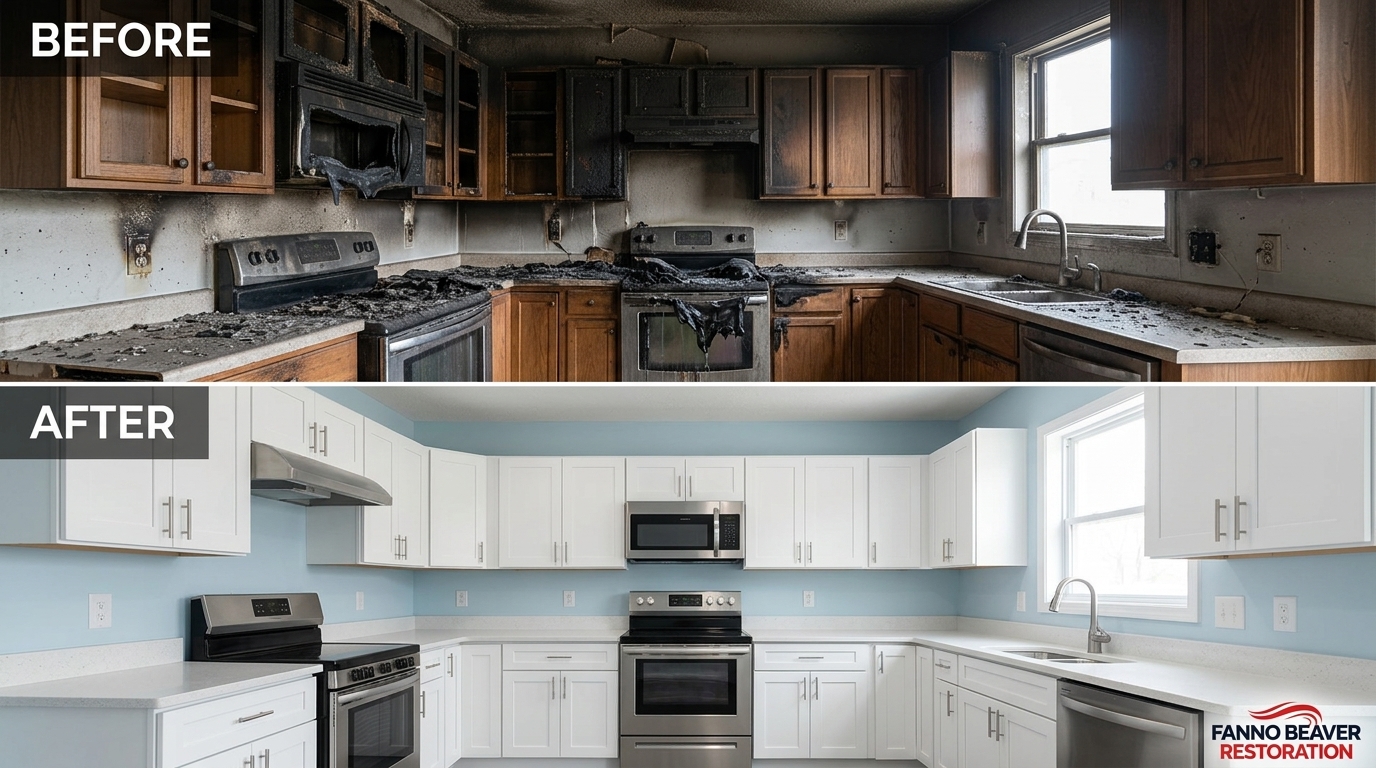
- Soot-blackened walls and ceilings → Clean, properly primed and painted surfaces confirmed soot-free by post-restoration inspection
- Persistent, pervasive smoke odor throughout the property → Zero detectable smoke odor after thermal fogging and hydroxyl treatment — confirmed by air quality instruments
- Char-damaged structural framing, floor joists, and subfloor → New structural materials installed to Oregon building code — documented with framing photos for insurance and resale
- HVAC ductwork coated with soot from recirculation during or after the fire → Fully cleaned, decontaminated HVAC system confirmed free of soot particulate before your family returns
- Wet, water-damaged insulation and drywall from firefighting → Completely removed, dried, and replaced with new materials — mold growth prevented rather than discovered months later
- Discolored, residue-covered surfaces in rooms adjacent to fire origin → Complete soot removal and surface restoration throughout every affected area — not just the room where the fire started
Fire Damage Restoration Equipment, Materials & IICRC-Certified Methods Used in Beaverton, Oregon
Professional-grade fire and smoke restoration technology — the equipment and methods that genuinely eliminate fire damage rather than masking it
Fanno Beaver Restoration uses IICRC-compliant equipment, manufacturer-approved restoration products, and certified application methods for every fire damage restoration project in Beaverton, OR. The equipment and techniques our FSRT-certified teams deploy are fundamentally different from anything available at a hardware store or employed by a general cleaning service — because fire and smoke damage penetrates at the molecular level and requires molecular-level treatment technology to address completely and permanently.
Soot & Smoke Residue Removal
- Dry chemical sponges — for dry, loose soot removal from walls and ceilings without smearing
- HEPA vacuum systems — for fine soot particle removal from surfaces and air
- Wet-cleaning solutions — formulated specifically for different soot types on porous and non-porous surfaces
- Ultrasonic cleaning equipment — for salvageable contents restoration
Smoke Odor Elimination
- Thermal foggers — penetrate wall cavities, fabric fibers, and porous materials at the same depth smoke originally traveled
- Hydroxyl generators — safe for occupied properties; eliminate odor molecules continuously during treatment
- Ozone treatment systems — deployed in unoccupied structures for maximum molecular odor elimination
Structural Drying & Moisture Control
- Industrial water extraction units — remove firefighting water from subfloor cavities, wall bases, and structural framing
- Low-grain refrigerant (LGR) dehumidifiers — structural drying to prevent post-fire mold growth
- High-velocity air movers — accelerate evaporation from wet structural materials
- Desiccant dehumidification systems — for deep structural drying in complex geometries
Air Quality & Environmental Control
- HEPA air scrubbers with negative air pressure systems — contain soot and smoke particulate during active restoration
- Thermal imaging cameras — detect hidden heat damage and moisture in wall cavities
- Moisture meters and hygrometers — track structural drying progress in real time
- Certified air quality testing instruments — confirm safe particulate and chemical compound levels before occupancy clearance
HVAC Decontamination
- Professional duct cleaning equipment — remove soot deposits from ductwork, air handlers, and registers
- Antimicrobial treatment products — prevent biological growth in cleaned HVAC systems
- Complete filter replacement — ensure no residual soot recirculation after restoration
Smoke & Soot Cleanup vs Full Fire Damage Restoration: Which Option Does Your Beaverton, OR Property Need?
Understanding surface smoke cleanup, partial fire restoration, and complete structural fire damage reconstruction — and why choosing the wrong scope costs more in the long run
One of the most important decisions Beaverton homeowners and property owners face after a fire loss is determining the correct scope of restoration — because choosing too little leaves hidden hazards and unresolved damage that surface as much larger problems months later, while an honest, thorough assessment upfront ensures your family returns to a genuinely safe, fully restored property. Fanno Beaver Restoration evaluates every Beaverton fire damage situation individually and recommends the appropriate restoration scope based on documented damage assessment, air quality data, and structural findings — not on what is fastest or easiest to sell.
| Restoration Option | What It Addresses | Key Advantages | Key Limitations | Best For |
|---|---|---|---|---|
| Surface Smoke & Soot Cleanup | Visible soot deposits and light smoke residue on accessible surfaces only | Fastest completion, lowest cost, minimal property disruption | Does not address smoke penetration inside wall cavities, attic spaces, HVAC systems, or structural framing | Minor smoke exposure from a quickly suppressed, contained fire with no structural involvement |
| Partial / Zone Fire Damage Restoration | Affected rooms or defined zones with moderate smoke, soot, and limited structural damage | Targeted scope reduces cost and timeline vs full restoration while addressing primary damage zones | May miss smoke penetration pathways that extend beyond the visually obvious damage zone | Moderate kitchen fires, small electrical fires contained to one area, minor structural involvement |
| Full Certified Fire Damage Restoration | Complete structure — fire origin area through all smoke-affected spaces, HVAC system, and structurally compromised framing | Most thorough outcome, strongest certified warranties, insurance-grade documentation, verified air quality clearance | Longer timeline and higher total project cost — but necessary and cost-effective for all significant fire losses | Any fire with structural involvement, HVAC smoke distribution, widespread soot, firefighting water damage, or insurance claim requirements |
When Full Certified Fire Damage Restoration Is Required
Fire involved or exposed structural framing, floor joists, rafters, wall studs, or roof decking to direct flame or radiant heat
HVAC system was operating during or after the fire and has distributed soot throughout the entire property
Air quality testing reveals airborne soot particulate, carbon compounds, or synthetic fire chemical residue above established safe thresholds
Firefighting water is present in walls, subfloor, insulation, or structural cavities — creating active mold growth risk within 24–48 hours
Insurance adjuster or Oregon building inspector requires FSRT-certified damage documentation and a certified scope of remediation
Property must pass occupancy inspection, real estate transaction inspection, lender appraisal, or insurance reinspection requiring written clearance
Electrical systems, panels, junction boxes, or wiring were exposed to fire heat, flames, or smoke — requiring professional electrical assessment before the property can be safely re-energized
Estimate Your Fire Damage Restoration Cost in Beaverton, OR — From Smoke Cleanup Pricing to Full Structural Restoration Budgets
Transparent fire damage restoration pricing, clear cost drivers, and written estimates that your insurance carrier can review and act on immediately
One of the first questions every Beaverton homeowner asks after a fire loss is what fire damage restoration is going to cost — and it is a completely reasonable question that deserves a completely honest answer. At Fanno Beaver Restoration, we use a detailed internal damage assessment process that factors in your property's total affected square footage, fire damage severity and type, smoke penetration depth, structural repair requirements, HVAC remediation scope, and contents restoration needs to produce a clear, itemized, written fire damage restoration estimate. That estimate goes directly to your insurance carrier and adjuster in a format they can review, verify, and act on — preventing the underpayment and claim disputes that happen when homeowners work with contractors unfamiliar with insurance restoration documentation requirements.
Primary Cost Drivers
| Restoration Scope | Typical Cost Range — Beaverton, OR | Common Scenario |
|---|---|---|
| Minor smoke & soot cleanup — 1 to 2 rooms | ~$1,500 – $4,500 | Small kitchen fire quickly suppressed, limited surface soot |
| Moderate fire damage restoration — partial home | ~$5,000 – $18,000 | Kitchen or electrical fire with adjacent room smoke damage |
| Significant fire damage with structural involvement | ~$20,000 – $50,000 | Room-of-origin fire, framing damage, HVAC contamination |
| Major structural fire damage restoration | ~$50,000 – $75,000+ | Multi-room fire, significant framing damage, major reconstruction |
| Severe or near-total loss restoration | $75,000+ — insurance-coordinated | Whole-structure fire, full reconstruction required |
All cost estimates are property-specific. Actual project costs depend on your property's specific damage scope, structural findings, material requirements, insurance coverage terms, and Oregon code compliance requirements. Fanno Beaver Restoration provides written estimates at no charge — call +1 (971) 462-1200 to schedule your free assessment.
Who Needs Complete Fire Damage Restoration vs Surface Smoke Cleanup in Beaverton, OR? — The Honest Assessment
When professional certified fire damage restoration is the only safe, appropriate, and insurance-compliant response for your Beaverton property
Fanno Beaver Restoration recommends complete certified fire damage restoration — rather than surface smoke cleanup or partial treatment — whenever the safety of your family, the structural integrity of your property, the quality of your air, or the requirements of your insurance policy and Oregon building code make a limited-scope response inadequate, potentially dangerous, or contractually insufficient. We make this recommendation based on documented assessment findings and air quality data — not on which option generates a larger project for our company.
Fire originated inside or directly involved structural framing members — floor joists, wall studs, rafters, roof decking, or subfloor — and structural integrity must be professionally assessed and documented
HVAC system was operating during or after the fire and has actively distributed soot particles and smoke compounds into every room and air space of the property
Air quality instrumentation detects airborne soot particulate, carbon compounds, or chemical fire residue above the established safe threshold for human occupancy
Firefighting water is present in structural cavities — walls, subfloor, insulation, ceiling assemblies — creating active mold growth risk that will materialize within 24–48 hours without professional water extraction and structural drying
Your insurance carrier, Oregon building inspector, or property lender requires FSRT-certified damage documentation, a certified remediation scope, and written occupancy clearance as a condition of claim processing, reinspection approval, or loan continuation
The property is involved in an active real estate transaction — sale, refinance, or purchase — and requires written professional fire damage clearance documentation to satisfy buyer, lender, or title company requirements
Electrical systems, panels, junction boxes, or any wiring was exposed to fire heat, open flames, or sustained smoke — making professional electrical assessment and restoration a safety prerequisite before the structure can be safely re-energized and re-occupied
The Real Benefits of Professional Fire Damage Restoration in Beaverton, OR — Beyond Appearance, Performance, Safety & Long-Term Value
Professional fire restoration is not just about how your property looks — it determines whether your family is genuinely safe, whether your insurance claim is paid fully, and whether your property retains its value after a fire loss
Attempting DIY fire damage cleanup or hiring an uncertified general contractor or cleaning service after a fire loss in Beaverton creates risks that are far more costly — financially and physically — than the professional fire damage restoration cost itself. Incomplete soot removal leaves carcinogenic particles in wall cavities and air circulation systems. Undetected structural damage creates safety hazards discovered months later during a home sale or after a second incident. Inadequate odor treatment means smoke smell returns within weeks as temperature and humidity change. And undocumented or uncertified restoration may give your insurance carrier grounds to dispute your claim or deny future coverage for the same property.
Complete smoke odor elimination — not masked with fragrance products that fail within weeks; thermal fogging and hydroxyl treatment eliminate odor at the molecular level throughout the entire structure
Professional soot removal from inside walls, HVAC systems, and structural framing — the contamination your family is breathing that no surface cleaner, shop vacuum, or general cleaning service can adequately address
FSRT-certified documentation gives your insurance carrier exactly what they need to process your claim correctly, pay you fairly, and close your file without dispute
Air quality testing and certified written clearance — legally defensible, instrument-verified evidence that your home meets safe occupancy standards; your family does not return based on your nose and eyes alone
Proper structural assessment reveals hidden fire damage before it becomes a catastrophic repair problem discovered during your next home sale, refinance, or insurance inspection
Direct insurance coordination by experienced restoration professionals maximizes your claim outcome, prevents adjuster underpayment, and ensures your scope of loss is fully documented and fairly compensated
Post-fire mold prevention through immediate water extraction and structural drying — preventing what would otherwise become a second, separate mold remediation claim adding significant additional cost to your recovery
Code-compliant reconstruction documentation — all structural work performed and documented to Oregon building code standards, satisfying future permit, inspection, and resale requirements
⚠️ Safety Alert: Do Not Re-Enter or Attempt DIY Cleanup of a Fire-Damaged Property in Beaverton, OR
The hazards left behind by fire damage are often invisible, toxic, and genuinely life-threatening — please read this before entering your property
After a fire — regardless of how small it appeared or how quickly it was suppressed — your property may present a superficially stable appearance while concealing multiple serious, invisible, and potentially life-threatening hazards. Soot particles from fire combustion, particularly from synthetic materials common in modern construction and furnishings, contain carcinogenic compounds that are immediately harmful to respiratory health upon inhalation. Structural members weakened by heat exposure can fail without visible warning. Electrical systems exposed to fire heat or smoke may re-ignite. HVAC systems that operated during the fire have distributed contaminated air throughout every room. And firefighting water in walls and subfloor is actively creating the conditions for rapid mold growth. Fanno Beaver Restoration's FSRT-certified team uses full personal protective equipment, air quality monitoring instruments, structural assessment protocols, and containment systems on every Beaverton fire damage project — so you, your family, and your pets never have to put yourselves at risk.
Do NOT re-enter a fire-damaged property until the Beaverton Fire Department or responding fire authority has issued official re-entry clearance
Do NOT attempt to clean soot with household cleaning products — dry soot smears permanently into porous surfaces when disturbed with water or household cleaners; you can make the damage significantly worse in minutes
Do NOT turn on or operate HVAC systems after a fire — this actively distributes soot particles and smoke chemical compounds from affected areas into every previously unaffected room and air space in your home
Do NOT assume the fire was minor based on what you can see — smoke and soot penetrate invisibly into wall cavities, attic spaces, insulation, and structural framing far beyond any visible damage zone
Do NOT eat or use any food, cookware, or appliances in a fire-damaged kitchen until professional cleaning and air quality clearance has been completed
Do NOT re-energize electrical systems that were exposed to fire heat, flames, or smoke without a professional electrical assessment — fire-damaged wiring is a re-ignition risk
Call Fanno Beaver Restoration immediately at +1 (971) 462-1200 — 24 hours a day, 7 days a week — if you discover any signs of fire, smoke, soot, or char damage at your Beaverton property
Fire Damage Restoration FAQs for Beaverton, OR Homeowners, Landlords & Property Owners
Honest answers about fire restoration cost, insurance coordination, smoke odor, safety timelines, and what to expect from the complete restoration process
Fire damage restoration costs in Beaverton, Oregon vary significantly based on the specific type of fire, the severity of structural damage, the extent of smoke penetration, the presence of firefighting water damage, and whether full structural reconstruction is required. Minor smoke and soot cleanup in one to two rooms may range from approximately $1,500 to $4,500. Moderate fire damage affecting multiple rooms typically runs between $5,000 and $18,000. Significant structural fire damage with framing involvement commonly ranges from $20,000 to $75,000 or more. Severe or near-total loss situations are handled on an insurance-coordinated basis with costs determined by full structural assessment. The good news is that most fire damage restoration in Beaverton is covered partially or fully by standard homeowner's insurance — and Fanno Beaver Restoration's team helps you navigate your claim from the first call to maximize your covered recovery. Call +1 (971) 462-1200 for your free, written, no-obligation fire damage restoration estimate.
The timeline for fire damage restoration in Beaverton depends entirely on the severity and scope of the damage. Minor surface smoke and soot cleanup in one or two rooms can typically be completed in one to five business days. Moderate fire damage restoration involving multiple rooms, odor elimination, and selective reconstruction usually takes one to three weeks. Full structural fire damage restoration with significant framing repairs, reconstruction, and air quality clearance typically requires four to twelve weeks depending on the scope. We provide a detailed written timeline estimate during your initial damage assessment so you can plan for temporary housing if needed and coordinate with your insurance carrier accordingly.
Yes — smoke odor can be completely and permanently eliminated when properly treated by certified professionals using the right equipment and methods. The key distinction is treatment approach. Consumer-grade air fresheners, scented candles, and household cleaning products do not eliminate smoke odor — they temporarily mask it at the surface while smoke chemical compounds remain embedded in wall cavities, insulation, and soft materials, causing the odor to return as temperature and humidity change. Fanno Beaver Restoration's FSRT-certified team uses thermal fogging, hydroxyl generation, and ozone treatment — technologies that penetrate the same depth smoke originally traveled and break down odor-causing molecules permanently — combined with thorough soot removal from all affected surfaces and complete HVAC system cleaning. When these methods are applied correctly by certified technicians, smoke odor is genuinely eliminated — not temporarily masked.
Yes — insurance coordination is a central and fully integrated part of our fire damage restoration service in Beaverton. From your very first call, our team begins creating the photo documentation and written damage assessment records your insurance carrier needs to process your claim. We produce a certified, itemized scope of restoration that satisfies the documentation requirements of all major carriers we work with — including Servpro, ServiceMaster Restore, 911 Restoration, Paul Davis Restoration, and Best Air Quality & Restoration. Our experienced team works directly with your assigned insurance adjuster throughout the entire project — providing supplemental documentation when needed, responding to adjuster questions, and ensuring that the full scope of your covered loss is documented and fairly compensated. We have helped hundreds of Washington County homeowners navigate fire damage insurance claims successfully.
In most situations involving significant fire, smoke, soot, or structural damage, temporary relocation during active restoration is strongly recommended — and in many cases required for health and safety reasons. During active soot removal, thermal fogging treatment, ozone application, and structural reconstruction, airborne particulate levels and chemical treatment compound concentrations in the work environment are not appropriate for occupants. Fanno Beaver Restoration provides clear occupancy guidance specific to your property's situation at your initial assessment, advises whether temporary relocation is necessary, and coordinates your return only after certified air quality testing confirms that your Beaverton home meets established safe occupancy thresholds. We provide written air quality clearance documentation — not just a verbal assurance — before your family returns.
You should call Fanno Beaver Restoration at +1 (971) 462-1200 as soon as the Beaverton Fire Department issues re-entry clearance — or even before that, so we can begin mobilizing immediately. Fire damage restoration outcomes are directly and significantly affected by how quickly professional response begins. Soot begins chemically etching non-porous surfaces like glass, metal, and finished wood within hours of a fire. Smoke odor compounds embed more deeply into porous materials the longer they remain untreated. And firefighting water in walls and subfloor begins producing the moisture conditions that lead to mold growth within 24 to 48 hours. Every hour of delay increases the scope of damage, the complexity of restoration, and ultimately the total cost of your recovery. We are available 24 hours a day, 7 days a week — call us now and we will guide you through the immediate steps while our team mobilizes.
Our Complete Beaverton Fire Damage Restoration Guarantee — Certified Work, Verified Safety, and Full Workmanship Protection
Your restored Beaverton property, backed by IICRC-certified technicians, documented air quality clearance, insurance-grade project records, and our complete workmanship commitment
Fanno Beaver Restoration stands behind every fire damage restoration project in Beaverton, Oregon with IICRC-certified installation and restoration standards, independently verified air quality clearance documentation, complete photographic project records, and our full workmanship commitment. When your family trusts us with their home after a fire loss, we understand that we are not just cleaning up a building — we are restoring the place your family lives, sleeps, and feels safe. Every decision our team makes on your project — from which soot removal method to apply to which reconstruction materials to use — is made with that responsibility in mind. We do not take shortcuts. We do not subcontract critical work to unknown crews. We do not hand you a cleanup invoice and leave unresolved hazards behind. Every Beaverton fire damage restoration project Fanno Beaver Restoration completes ends with a certified air quality clearance, a complete warranty package, and the documented confirmation that your home is genuinely, verifiably safe for your family.
Since 2015, homeowners, landlords, and property owners throughout Beaverton, Washington County, and the Tualatin Valley Region — from historic properties near the Belle Ainsworth Jenkins Estate and Cooper Mountain to modern communities in Sexton Mountain, Five Oaks, and Greenway — have trusted Fanno Beaver Restoration to restore their properties after fire losses with certified expertise, genuine compassion, complete documentation, and results that stand up to insurance scrutiny, building inspection, and the test of time.
Fire Damage Restoration Beaverton OR Service Area Coverage
When responding to fire damage emergencies in Beaverton, our restoration team navigates the Tualatin Valley region efficiently — from Nike World Headquarters area and Progress Ridge TownSquare, through Tigard and Cedar Hills Crossing, across Washington, Multnomah, and Clackamas Counties.
Cities We Serve Near Beaverton OR
Get Emergency Fire Damage Restoration Services Beaverton OR Now
Need an emergency fire damage restoration company in Beaverton OR? Our 30 skilled professionals are standing by 24/7. Whether you need fire damage restoration, mold remediation, basement flood cleanup, or emergency water damage restoration in Beaverton OR — we're always ready to help.
Contact Fanno Beaver Restoration
(971) 462-1200
fannobeaverrestoration@gmail.com
10300 SW Nimbus Ave
Beaverton, OR 97223
Washington County
Monday – Sunday: 00:00 – 23:59
24/7 Emergency Service Always Available