Basement Flood Cleanup in Beaverton, OR — Professional Basement Water Extraction, Structural Drying & Complete Flood Damage Restoration for Your Home or Business
Same-Day Basement Flood Cleanup in Beaverton — Serving Central Beaverton · Five Oaks · Sexton Mountain · Greenway · West Beaverton · South Beaverton · Denney Whitford · Vose · Highland · Neighbors Southwest Since 2015
When your Beaverton basement is flooded — whether from a burst pipe, sump pump failure, sewage backup, Fanno Creek corridor groundwater rise, or sustained Pacific Northwest storm flooding — every minute of standing water in your basement multiplies your structural damage, accelerates mold colonization, and compounds the total cost of restoring your property. Fanno Beaver Restoration delivers fast, certified basement flood cleanup in Beaverton, Oregon — dispatching our 30-person team of WRT, ASD, and AMRT-certified basement flood restoration professionals with 5 fully loaded service vans equipped with industrial submersible pumps, truck-mounted extraction units, commercial LGR dehumidifiers, thermal imaging cameras, and complete antimicrobial treatment systems so your flooded Beaverton basement is extracted, dried, sanitized, and restored to safe, dry, habitable condition as rapidly and completely as certified professional basement flood cleanup can achieve. Beaverton's basements face some of the most demanding flood conditions in the Pacific Northwest — and Fanno Beaver Restoration is the certified local team built to handle every one of them, 24 hours a day, 365 days a year.
- Local Beaverton, OR basement flood cleanup contractor since 2015
- WRT · ASD · AMRT · CDS · FSRT certified basement flood restoration professionals
- Industrial submersible pumps and truck-mounted extraction — thousands of gallons removed rapidly
- 30 in-house professionals and 5 fully loaded service vans — no subcontracting, no delays
- Complete basement flood cleanup — extraction, drying, sanitizing, mold prevention, and reconstruction
- Direct insurance carrier coordination and complete flood damage documentation included
- Serving all Beaverton neighborhoods plus Aloha, Hillsboro, Tigard, Tualatin, Lake Oswego, and 15+ surrounding communities
24/7 True Emergency Basement Flood Cleanup in Beaverton, OR — Live Answer, Immediate Dispatch, Industrial Extraction Equipment on Every Van
Request Emergency Basement Flood Cleanup
Fill out the form below and we'll contact you immediately!
Award-Winning Basement Flood Cleanup in Washington County & the Tualatin Valley
Top-rated certified basement flood cleanup team serving Beaverton and Greater Portland Metro since 2015
Fanno Beaver Restoration is a fully certified basement flood cleanup contractor with 10+ years of hands-on experience extracting floodwater, drying basement structural systems, and completely restoring flood-damaged basements across Beaverton, Washington County, and the surrounding Tualatin Valley region. Holding the complete IICRC certification stack — including Water Damage Restoration Technician (WRT), Applied Structural Drying (ASD), Applied Microbial Remediation Technician (AMRT), Commercial Drying Specialist (CDS), and Fire and Smoke Damage Restoration Technician (FSRT) credentials — Fanno Beaver Restoration delivers the same caliber of certified professional basement flood cleanup as national industry leaders including Servpro, ServiceMaster Restore, and Restoration 1, with the deep local knowledge of Beaverton's specific basement flooding risk factors, neighborhood drainage patterns, and seasonal groundwater conditions that only a dedicated Beaverton-based team can provide. Every basement flood cleanup project is backed by our regional awards for Best Air Quality and Restoration Excellence and our Flood Department and Compassion Clean specialist recognition.
Basement Flood Cleanup for Homes & Businesses Near Beaverton's Landmarks, Parks, Waterways & Community Hubs
From the Fanno Creek Greenway corridor and Tualatin Hills Nature Park to Nike World Headquarters neighborhoods, Progress Ridge TownSquare communities, and the historic Jenkins Estate area — we respond to flooded basements everywhere in Beaverton
Fanno Beaver Restoration responds to basement flood cleanup emergencies throughout every corner of Beaverton, Oregon — from established historic neighborhoods surrounding the Belle Ainsworth Jenkins Estate and the Historic Jenkins Estate (THPRD) where older basement construction and aging drainage infrastructure create recurring flood vulnerability, to modern developments built around Nike World Headquarters, Progress Ridge TownSquare, and the Patricia Reser Center for the Arts where basement flooding from sump pump failures and storm drainage system overload affects newer homes and commercial properties. Beaverton's geography creates basement flooding conditions that are fundamentally different from — and more severe than — what most Pacific Northwest cities experience: the Fanno Creek Greenway running directly through the heart of Beaverton creates a below-grade groundwater corridor that raises seasonal water tables in the basements of homes throughout Central Beaverton, Five Oaks, South Beaverton, and Denney Whitford; the Tualatin River lowlands to Beaverton's south create sustained hydrostatic pressure against the foundation walls of thousands of Beaverton homes during the October-through-March wet season; and the dense forested slopes of Tualatin Hills Nature Park, Cooper Mountain Nature Park, and Hyland Forest Park generate rapid surface runoff during heavy rainfall events that overwhelms Beaverton's storm drainage infrastructure and backs groundwater into basement spaces across all of West Beaverton, Sexton Mountain, and Neighbors Southwest. Understanding these specific Beaverton basement flooding risk factors is what separates a certified local basement flood cleanup team from a generic restoration contractor.
Beaverton Neighborhoods & Communities We Serve
- Central Beaverton
- Denney Whitford / Raleigh West
- Five Oaks / Triple Creek
- Greenway
- Highland
- Neighbors Southwest
- Sexton Mountain
- South Beaverton
- Vose
- West Beaverton
- West Slope
Historic & Cultural Landmarks
- Belle Ainsworth Jenkins Estate
- Historic Jenkins Estate (THPRD)
- Patricia Reser Center for the Arts
- The Round at Beaverton Central
- Icarus at Kittyhawk Sculpture (Beaverton Central MAX Station)
- Three Creeks One Will Sculpture (The Round South Plaza)
- Beaverton Historical Society
- Beaverton City Hall and The Round Area
- Beaverton Downtown District
Nature Parks, Greenways & High-Risk Waterway Corridors
- Tualatin Hills Nature Park · Tualatin Hills Nature Center
- Cooper Mountain Nature Park
- Fanno Creek Greenway · Fanno Creek Trail
- Millikan Way Nature Trail
- Hyland Forest Park · Hyland Woods Natural Area
- Magnolia Park · Cedar Hills Park · Hidden Creek Park
- Mountain View Champions Park · Vista Brook Park
- Evelyn M. Schiffer Memorial Park · Barsotti Park
- Tualatin Hills Park & Recreation District Complex
- Beaverton Swim Center · Aloha Swim Center
Shopping, Business & Community Hubs
- Cedar Hills Crossing
- Progress Ridge TownSquare (Cinetopia / AMC Progress Ridge)
- Beaverton Farmers Market · Beaverton Winter Farmers Market
- BG's Food Cartel · Beaverton City Library
- Nike World Headquarters
- Cooper Mountain Vineyards
- Downtown District
Nearby Regional Attractions
- Washington Park · Oregon Zoo · Portland Japanese Garden
- International Rose Test Garden · Hoyt Arboretum
- World Forestry Center Discovery Museum · Pittock Mansion
- Forest Park (Wildwood Trail / Lower Macleay Trail)
- Tom McCall Waterfront Park · Powell's City of Books
- Portland Art Museum · Lan Su Chinese Garden
- Oregon Museum of Science and Industry (OMSI)
All Nearby Service Area Cities
Beaverton's Basement Flood Cleanup Specialists — Not a Generic Pump-Out Service or Surface-Only Cleanup Operation
Complete certified basement flood cleanup — industrial extraction, below-grade structural drying, mold prevention, sewage sanitization, content handling, and full basement restoration — done correctly from first response through final documentation
Fanno Beaver Restoration focuses exclusively on certified basement flood cleanup and complete below-grade flood restoration — not pump-out-and-leave operations that remove standing water while leaving thousands of gallons of structural moisture trapped inside basement walls, concrete block cavities, floor assemblies, insulation systems, and the drywall and framing of finished basement spaces. Our IICRC-certified basement flood cleanup crews perform full industrial water extraction from all basement floor levels and material types, certified below-grade structural drying using commercial equipment precisely configured for the specific drying challenges of below-grade spaces, EPA-registered antimicrobial treatment of all flood-contacted surfaces, AMRT-certified mold prevention protocols, complete content documentation and handling, and comprehensive flood damage documentation for insurance claims — so your basement flood cleanup in Beaverton, OR resolves the flooding event completely. Whether you are facing a Category 1 groundwater intrusion basement flood, a Category 2 sump pump failure, or a Category 3 sewage backup that has contaminated your entire basement with biohazardous black water, we design and execute the right certified basement flood cleanup response for your specific Beaverton property.
When Do Beaverton Homeowners and Property Managers Need Professional Basement Flood Cleanup?
Signs that your flooded basement requires more than a shop vac and household fans — and why below-grade flood damage spreads faster and deeper than above-grade water events
Basement flooding is fundamentally different from above-grade water damage — and more dangerous to defer. Below-grade spaces have limited air circulation that dramatically slows natural drying, concrete and masonry construction that absorbs and retains water for extended periods, direct contact with soil moisture and groundwater that provides a continuous moisture source even after standing water is removed, and cool temperatures that slow evaporation while supporting the temperature range in which mold thrives most aggressively. In Beaverton's Pacific Northwest climate — where October through March brings sustained rainfall events that raise the Fanno Creek watershed water table, push hydrostatic pressure against basement foundation walls throughout South Beaverton, Five Oaks, and Central Beaverton, and overload municipal storm drainage systems that back water into basement floor drains across the entire city — basement flooding events are not rare surprises. Most Beaverton homeowners facing any basement flooding event beyond the most minimal surface moisture will need certified professional basement flood cleanup — not DIY shop vac extraction — to prevent a flooded basement from becoming a catastrophically damaged, mold-colonized, structurally compromised below-grade space.
Who Our Basement Flood Cleanup Service Is For in Beaverton, OR
Homeowners, landlords, property managers, business owners, and investors facing urgent basement flooding throughout Beaverton and Washington County
Fanno Beaver Restoration provides certified basement flood cleanup for single-family homes with finished and unfinished basements, rental properties, condominiums with below-grade storage or utility spaces, multi-family buildings, and small commercial properties with below-grade areas throughout all Beaverton neighborhoods and the surrounding Washington County Tualatin Valley communities. Basement flooding does not discriminate by neighborhood, property age, or construction type — it affects homes in historic Beaverton neighborhoods with aging foundation drainage as readily as it affects modern homes in planned communities where storm drainage system capacity is overwhelmed by Beaverton's increasingly intense seasonal rainfall events.
Homeowners in Central Beaverton, Five Oaks, Sexton Mountain, Greenway, West Beaverton, South Beaverton, Vose, Highland, Denney Whitford, and Neighbors Southwest with flooded finished or unfinished basements from burst pipes, sump pump failures, storm flooding, sewage backups, or Fanno Creek corridor groundwater intrusion who need immediate certified basement flood cleanup
Landlords and residential property managers with rental properties featuring below-grade apartments, basement storage units, or utility spaces in established Beaverton neighborhoods who need rapid certified basement flood cleanup to restore habitability, fulfill Oregon landlord-tenant obligations, protect tenant safety, and limit legal liability
Home buyers, sellers, and real estate professionals who have discovered basement flooding history, active moisture intrusion, or incomplete prior basement flood cleanup during pre-listing or buyer inspection — needing certified professional basement assessment, complete cleanup documentation, and moisture verification records
Small business owners and commercial property managers with below-grade retail, storage, server rooms, or office spaces near Progress Ridge TownSquare, Cedar Hills Crossing, the Nike World Headquarters corridor, and Beaverton's Downtown District who need fast certified basement flood cleanup that minimizes inventory loss and business interruption
Properties near Fanno Creek, Tualatin Hills Nature Park, Cooper Mountain Nature Park, Tualatin River lowlands, and Hyland Forest Park waterway corridors where seasonal groundwater table rise, surface runoff, and storm drainage overflow create recurring annual basement flooding conditions requiring professional cleanup and documentation each wet season
Remote property owners, out-of-state investors, and absentee landlords with Beaverton area properties featuring below-grade spaces who need a fully trustworthy local basement flood cleanup partner providing complete photo documentation, certified moisture verification records, transparent itemized billing, and direct insurance carrier communication
Properties with recurring basement flooding history — Beaverton homeowners whose basements have flooded multiple times in prior seasons whose prior cleanup attempts were incomplete or whose drainage systems require assessment alongside certified cleanup to break the cycle of recurring basement flood damage
Beaverton, OR Climate and Basement Flood Cleanup — Why Local Conditions Make Professional Response Non-Negotiable
How Beaverton's Pacific Northwest rainfall, Fanno Creek watershed geography, Tualatin River lowlands, and year-round elevated soil moisture create unique and urgent basement flooding cleanup needs
No other aspect of Beaverton's geography creates more property damage for more homeowners more consistently than the combination of sustained Pacific Northwest rainfall, the Fanno Creek watershed running directly through the city, the Tualatin River lowlands to the south, and the densely forested hillside terrain of Tualatin Hills and Cooper Mountain that generates massive surface runoff volumes during heavy storm events. Beaverton averages over 37 inches of annual rainfall concentrated in sustained multi-day events between October and March — but the raw precipitation number understates the basement flooding risk, because Beaverton's clay-rich soils have limited infiltration capacity, meaning that a significant proportion of every rainfall event becomes surface runoff or shallow groundwater that moves directly toward the lowest points of the landscape: Fanno Creek, the Tualatin River lowlands, and the basements of thousands of Beaverton homes built in those watershed corridors. The seasonal rise of the Fanno Creek watershed water table between November and April pushes groundwater against foundation walls and beneath concrete slab floors throughout Central Beaverton, South Beaverton, Five Oaks, and Denney Whitford neighborhoods — making certified professional basement flood cleanup in Beaverton, OR not just preferable but genuinely essential for protecting below-grade property investments.
Fall — September through November
Beaverton's first significant Pacific storm systems strike soil that has dried and contracted over summer, initially absorbing rainfall rapidly before quickly reaching saturation. The first major storm events regularly overwhelm residential sump pump systems that have sat idle since spring, revealing pump failures homeowners discover only when basement flooding is already underway. Fanno Creek begins rising to its autumn baseline level, beginning the months-long period of elevated groundwater pressure against the foundation walls of homes throughout Central Beaverton and South Beaverton. Properties with unresolved basement moisture issues from the previous wet season begin showing active mold growth in damp below-grade spaces across Sexton Mountain, Five Oaks, and Highland neighborhoods.
Winter — December through February
Beaverton's highest-volume rainfall months create the most severe basement flooding conditions the city experiences. Sustained multi-day precipitation events maintain soil at or near full saturation throughout Washington County, pushing groundwater tables to annual peak levels that can raise water above basement slab level in the lowest-elevation properties near the Fanno Creek Greenway and Tualatin River corridors. Municipal storm drainage systems operating at full capacity back water through floor drains into basements across South Beaverton, West Beaverton, and Denney Whitford. Sump pumps operating continuously for days overheat and fail — releasing accumulated groundwater into finished basement spaces. Rare cold snaps cause water supply pipes to freeze and burst in basement mechanical spaces. Winter is Fanno Beaver Restoration's highest-volume basement flood cleanup season.
Spring — March through May
Warming temperatures and increasing daylight in spring cause Beaverton homeowners to venture into basements that were avoided during winter's cold wet months — and frequently discover months of accumulated basement moisture damage. Mold colonies established during November through February become visible and strongly olfactory as spring temperatures warm basement spaces above 60°F. Basement wall insulation that absorbed moisture during winter reveals itself through water staining and mold growth visible at wall-floor joints. Spring is Beaverton's primary season for discovering the consequences of incomplete or absent professional basement flood cleanup during the preceding wet season.
Summer — June through August
Beaverton's dry summers create a window of reduced active flooding risk — but summer is when the full financial and health consequences of inadequate basement flood cleanup from the prior wet season become fully apparent. Mold colonies in basement wall cavities expand aggressively in summer's warmer temperatures, producing strong musty odors that permeate the entire home through HVAC systems. Structural deterioration from months of elevated moisture becomes visible as floor deflection and wall deformation. Summer is also the optimal season for addressing drainage system improvements, sump pump upgrades, and waterproofing measures that prevent recurring wet-season basement flooding — and for completing basement restoration and reconstruction from prior flooding damage.
Basement Flooding Sources, Water Categories & Cleanup Approaches: Understanding Your Basement Flood Cleanup Needs in Beaverton, OR
Not all basement flooding is the same — the flood source, water category, and basement construction type determine your cleanup method, health risk level, structural impact, and total restoration scope
When Fanno Beaver Restoration responds to a basement flood cleanup call in Beaverton, our first priority upon arrival is assessing the flooding source, classifying the water category using IICRC S500 Standard protocols, evaluating the basement construction type and its specific drying challenges, and identifying the full extent of structural saturation using thermal imaging and calibrated moisture metering. Basement flooding source and water category classification determines everything that follows — the extraction approach, the health and safety protocols required, the materials that can be salvaged vs. must be removed, the antimicrobial treatment requirements, and the structural drying equipment configuration.
| Flooding Source | Common Beaverton Scenarios | Water Category | Primary Cleanup Challenge |
|---|---|---|---|
| Groundwater Intrusion | Fanno Creek watershed water table rise, hydrostatic pressure through foundation cracks, Tualatin River lowland saturation | Category 1 initially; may escalate with soil contamination | Continuous moisture source — extraction alone insufficient without addressing intrusion point |
| Sump Pump Failure | Pump overload during extended storms, power outage, float switch failure, check valve failure | Category 1 to Category 2 depending on water source and duration | High volume release; pump system failure diagnosis required alongside cleanup |
| Storm Drain Backup | Municipal storm drain overload backing water through floor drains, window well overflow | Category 2 to Category 3 depending on contamination level | External contamination requires enhanced antimicrobial protocols |
| Burst or Frozen Pipes | Supply line failure in basement mechanical space, frozen pipe burst in exterior wall penetration | Category 1 clean water initially | High-volume rapid release, full basement saturation of all floor assemblies |
| Sewage Backup | Lateral line blockage, main line surcharge, municipal sewer backup through floor drain | Category 3 — biohazardous black water | Full biohazard protocols, complete porous material removal, AMRT sanitization |
| Appliance Failure | Water heater tank rupture, washing machine drain failure, basement bathroom fixture overflow | Category 1 to Category 2 depending on appliance and duration | Localized high-volume release requiring rapid extraction before spread to finished areas |
| Roof and Downspout Drainage | Improper grading directing roof runoff toward foundation, downspout discharge near foundation | Category 1 initially; surface contamination possible | Drainage correction required alongside cleanup to prevent recurrence |
| Window Well Flooding | Window well drain failure or blockage during heavy rainfall, allowing water entry through basement windows | Category 1 to Category 2 | Window well drainage repair required alongside cleanup |
Basement Construction Type Impact on Cleanup Scope
| Basement Type | Beaverton Prevalence | Specific Cleanup Challenges |
|---|---|---|
| Poured Concrete Foundation | Common in post-1960s Beaverton homes | Concrete absorbs and retains moisture at depth; requires extended drying cycles and monitoring |
| Concrete Block / CMU Foundation | Common in pre-1970s Central Beaverton and Denney Whitford homes | Block cavities fill with water and must be addressed; slow drying, high mold risk in cavity spaces |
| Finished Basement with Drywall & Flooring | Increasingly common across all Beaverton neighborhoods | Interior finish materials must be assessed for removal vs. retention; hidden moisture behind finished walls requires thermal imaging |
| Unfinished Basement with Exposed Concrete | Common in older Beaverton homes | Faster assessment and drying access; structural materials visible for direct moisture measurement |
| Basement with Carpet and Pad | Common in finished basement spaces throughout Beaverton | Carpet and pad almost always require removal after significant flooding — they cannot be dried to safe moisture levels and become immediate mold substrate |
| Basement with Hardwood or LVP Flooring | Increasingly common in newer Beaverton homes | Material-specific drying assessment required; hardwood may cup and require replacement; LVP typically requires removal and replacement |
Basement Flooding Event Types in Beaverton
Our Certified 6-Step Basement Flood Cleanup Process in Beaverton, OR
From your emergency call to your final documented basement restoration walkthrough — a complete, properly sequenced, IICRC-standard certified cleanup process with no shortcuts and no pump-and-leave operations
⚡ Step 1: 24/7 Emergency Basement Flood Dispatch, Live Response & Immediate On-Site Assessment
When you call +1 (971) 462-1200 to report a flooded basement in Beaverton, you immediately reach a live Fanno Beaver Restoration team member — not an answering service, not voicemail, not an automated system. Our basement flood cleanup coordinator takes your flooding details, assesses the situation for immediate safety concerns — particularly electrical hazards from water contacting basement electrical panels, outlets, and appliances — dispatches the appropriate crew and extraction equipment immediately, and provides you with arrival time confirmation and first-response safety instructions while our team is en route.
Upon arrival, our WRT-certified lead technician conducts a complete basement flood assessment: FLIR thermal imaging of all basement walls, floors, ceiling assemblies, and wall-floor joints to identify the full extent of water migration including areas not visible to the naked eye; calibrated moisture metering to establish baseline saturation levels throughout the basement; flooding source identification and assessment; water category classification per IICRC S500 protocols — determining whether the flooding event is Category 1 clean water, Category 2 gray water, or Category 3 sewage/black water; and complete before-work photo documentation of standing water depth, material saturation, content damage, and all visible structural conditions for insurance claim records.
🔒 Step 2: Flooding Source Control, Safety Stabilization & Basement Containment
Before extraction equipment is deployed, our team addresses the flooding source and makes the basement safe to work in. This includes: identifying and controlling the water source — shutting off basement supply lines, coordinating with plumbers for pipe repairs, assessing sump pump failure and arranging temporary sump pump deployment, or installing window well covers and temporary exterior drainage diversions for storm intrusion events. Basement electrical safety is assessed — we coordinate with your utility provider for power disconnection in flooded basements where water has contacted electrical systems, and do not allow crew members into standing water areas until electrical safety is confirmed. In Category 3 sewage flooding events, full containment barriers and negative air pressure systems are established before any extraction work begins, isolating the contaminated basement space from the rest of the home to protect occupants from biohazardous airborne contamination.
💧 Step 3: Industrial Basement Water Extraction & Standing Water Removal
With safety established and the flooding source controlled, our crew deploys the full extraction capability required for your specific basement flooding scenario. For basements with significant standing water, we deploy submersible electric pumps capable of moving up to 18,000 gallons per hour to rapidly remove bulk standing water from the basement floor before switching to high-efficiency extraction units for residual water removal. Truck-mounted extraction units producing 200+ inches of water lift are used for maximum suction power on residual water in carpet, padding, and floor assemblies. Specialized basement extraction tools are deployed for water extraction from between hardwood flooring boards, from beneath vinyl plank flooring systems, and from carpet and padding layers to maximum depth before these materials are assessed for removal vs. retention decisions. Water in concrete block cavity spaces is addressed using specialized injection and extraction techniques designed specifically for the masonry construction common in older Beaverton basements near Central Beaverton and Denney Whitford. Every gallon of water extracted from the basement floor during this phase is a gallon that does not migrate further into basement wall assemblies, flooring systems, and foundation structure during the following drying phase.
🌀 Step 4: Certified Below-Grade Structural Drying, Dehumidification & Daily Moisture Monitoring
Following complete standing water extraction, our Applied Structural Drying (ASD) certified technicians calculate the precise equipment configuration required to achieve certified-dry conditions in your specific Beaverton basement — accounting for the basement's construction type (poured concrete vs. concrete block vs. finished drywall assemblies), the specific materials requiring drying, the basement's volume and air circulation characteristics, and the psychrometric conditions required to achieve maximum drying efficiency in below-grade environments where natural air circulation is severely limited.
Commercial LGR (Low Grain Refrigerant) dehumidifiers draw moisture from concrete slab, masonry walls, framing assemblies, and finished basement materials at rates that consumer-grade basement dehumidifiers cannot begin to approach. High-velocity air movers are positioned in calculated configurations that overcome below-grade air circulation limitations. Where finished basement walls prevent direct access to structural moisture in wall cavities, our technicians use wall cavity drying panels that inject conditioned air directly into the wall assembly through small-diameter access points, drying structural framing and insulation from the inside without requiring complete drywall demolition in appropriate cases. Our technicians return to your Beaverton basement daily to record calibrated moisture readings at all monitored points, adjust equipment placement and settings, and confirm that all materials are tracking toward IICRC-certified dry targets. Drying is not declared complete based on the basement feeling dry — it is declared complete based on calibrated moisture readings reaching IICRC S500 standard dry conditions.
🧪 Step 5: Mold Prevention, Antimicrobial Treatment, Content Handling & Air Quality Restoration
Once basement structural drying targets are confirmed through calibrated moisture readings throughout all monitored assemblies, our AMRT-certified technicians apply EPA-registered antimicrobial treatments to all basement surfaces that experienced flood water contact — including concrete floors and walls, masonry block surfaces, exposed framing lumber, drywall surfaces remaining after any removal, and all penetrations, utility chases, and mechanical spaces where flood water migrated. In Category 2 and Category 3 flooding events, all porous materials that did not achieve certified dry conditions during the drying phase are removed and properly disposed of per Oregon environmental regulations before antimicrobial treatment of remaining structural surfaces proceeds.
HEPA-filtered air scrubbers are operated continuously throughout the basement during all Category 2 and Category 3 cleanup projects and any project involving mold-affected materials, protecting both your family and our crew from airborne particulate, mold spores, and microbial contaminants disturbed during basement extraction and cleanup operations. Your basement contents — furniture, stored personal property, appliances, electronics, recreational equipment — are carefully inventoried, photographed, and assessed for restoration vs. disposal with complete documentation for insurance content claims.
✅ Step 6: Final Moisture Certification, Damage Documentation, Reconstruction Scoping & Walkthrough
When all basement structural materials reach certified dry conditions across all monitored points — confirmed by final calibrated moisture readings throughout the entire basement — our project lead completes the final basement flood cleanup certification documentation: a complete psychrometric drying log showing daily readings, equipment deployment records, and final certified-dry measurements throughout your Beaverton basement that satisfies IICRC S500 standards and insurance adjuster requirements. We provide you with a complete written basement damage assessment identifying all materials removed during cleanup, all structural repairs required as a result of the flooding event, and a clear scope of work for basement reconstruction and restoration that you can use to obtain contractor bids or engage our reconstruction coordination services.
We walk through your cleaned, dried, and documented basement with you in person — showing you before-and-after moisture readings at key structural points, reviewing all completed extraction and cleanup work, answering every question about what was done and why, reviewing all warranty and insurance documentation, and providing written guidance on drainage maintenance, sump pump testing, and basement moisture prevention measures specific to your Beaverton property's flooding risk profile. You leave the final walkthrough with a complete basement flood cleanup project file — documentation, moisture certifications, photos, and reconstruction scope.
What's Included in Our Beaverton, OR Basement Flood Cleanup Service Package
From your first emergency call through final certified documentation — a complete, transparent, turnkey basement flood cleanup and restoration package with no hidden exclusions and no pump-and-leave shortcuts
When you call Fanno Beaver Restoration for basement flood cleanup in Beaverton, you receive a fully integrated, end-to-end basement flood cleanup and restoration package — not a pump-out service that removes standing water and leaves your structural drying, mold prevention, content handling, and insurance documentation as your problem to solve separately. Our basement flood cleanup package is designed to handle every aspect of your flooded basement situation from the moment you call through the moment your basement is certified dry, professionally restored, and fully documented.
Basement Flood Cleanup Service Area Coverage — Beaverton OR & Washington County
When responding to basement flood cleanup emergencies in Beaverton, our restoration team navigates the Tualatin Valley region efficiently — from Nike World Headquarters area and Progress Ridge TownSquare, through Tigard and Cedar Hills Crossing, across Washington, Multnomah, and Clackamas Counties.
Cities We Serve Near Beaverton OR
Beaverton's Trusted Basement Flood Cleanup Team — The Fanno Beaver Restoration Difference
Local basement flood expertise, full IICRC certification, genuine 24/7 availability, industrial extraction capacity, and transparent communication when your basement is underwater
When your Beaverton basement is flooded, you need more than a company with a pump truck and a phone number. You need a certified team that understands Beaverton's specific basement flooding risk factors — the Fanno Creek watershed, the Tualatin River lowlands, the clay-rich soil hydrology, and the aging concrete block foundations of older Beaverton homes. Fanno Beaver Restoration answers at any hour, dispatches immediately with industrial extraction equipment, communicates clearly about every finding, and works directly with your insurance carrier throughout the process.
10+ Years Local Experience
Serving Beaverton, Washington County, and the Tualatin Valley since 2015 — deep local knowledge of seasonal flooding patterns, neighborhood drainage, and below-grade construction types.
Full IICRC Certification
WRT · ASD · AMRT · CDS · FSRT — the complete certification stack for basement extraction, structural drying, mold prevention, sewage remediation, and full restoration.
30 In-House Professionals
Every technician is a direct Fanno Beaver Restoration employee — background-checked, IICRC-trained, and accountable to our standards. Never subcontracted to unknown parties.
5 Fully Loaded Service Vans
Every van carries industrial submersible pumps, truck-mounted extraction units, commercial LGR dehumidifiers, FLIR thermal imaging cameras, and complete antimicrobial systems.
True 24/7/365 Live Answer
We answer every basement flood call personally — including during Beaverton's peak January storm events when flooding is most severe and most other contractors are unavailable.
Direct Insurance Coordination
We communicate with your adjuster, submit all IICRC-certified documentation, handle supplement requests, and advocate for complete covered restoration reimbursement.
Award-Recognized Excellence
Best Air Quality & Restoration Regional Award and Flood Department & Compassion Clean Specialist Recognition — earned specifically through basement flood restoration performance.
Before & After: Real Beaverton Basements Fully Restored From Flooding to Certified Dry
Certified industrial extraction, below-grade structural drying, and professional basement restoration transforms flooded Beaverton basements back into safe, dry, usable spaces
Every basement flood cleanup project Fanno Beaver Restoration completes in Beaverton is documented with comprehensive before-and-after photo records and moisture logs — from initial emergency assessment photographs showing standing water depths and thermal imaging revealing hidden moisture migration, to final certification photographs showing calibrated moisture readings at certified-dry levels across all monitored basement structural points. Our Beaverton basement flood cleanup portfolio demonstrates a single truth: fast, certified professional basement flood response prevents catastrophic structural and financial loss.
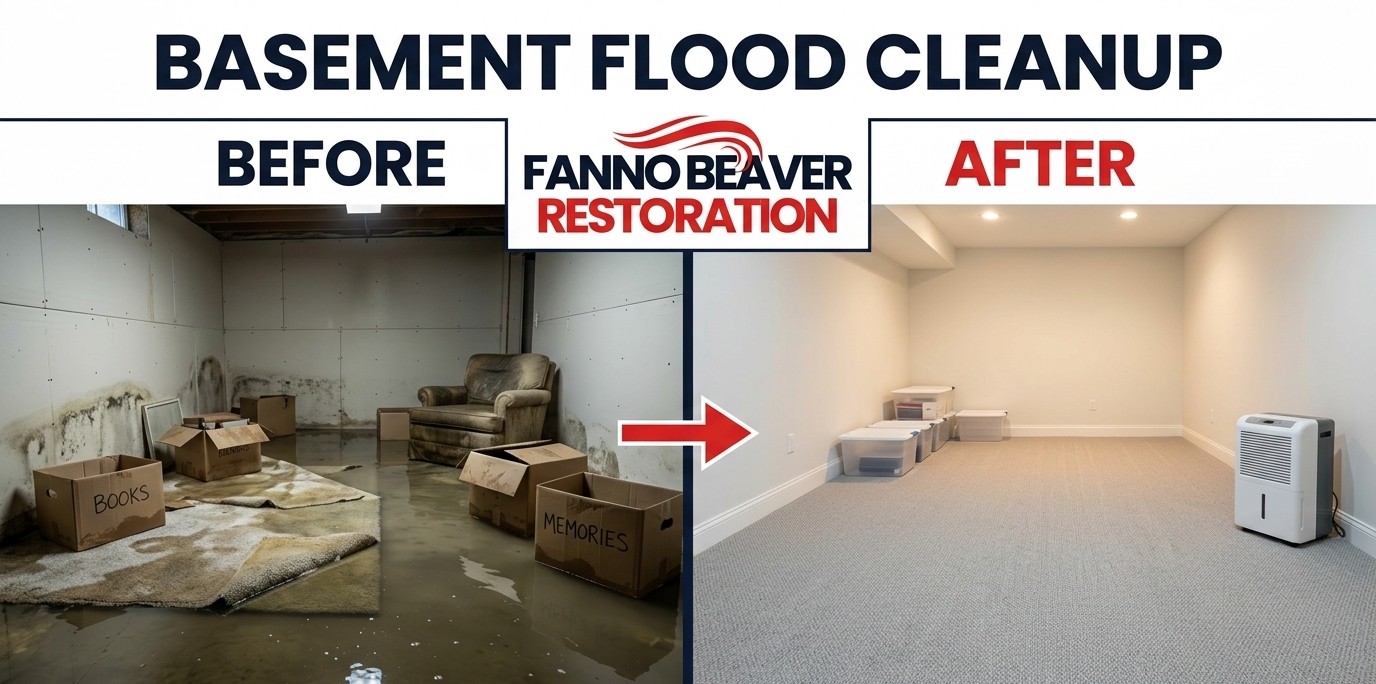
A sump pump motor failure during a sustained January storm released accumulated groundwater into a 1,200 sq. ft. finished basement over 18 hours. Our team deployed industrial submersible pumps, truck-mounted extraction for carpet and pad, and 6 days of certified below-grade structural drying — preventing an estimated $40,000 in mold remediation and reconstruction.
A property near the Fanno Creek Greenway had experienced three years of incomplete basement flood cleanup. Our comprehensive restoration included AMRT-certified mold remediation, full finished basement material removal and reconstruction, and concrete block cavity drying — ending the annual cycle of recurring basement damage.
A main line sewage backup released sewage-contaminated water throughout an unfinished basement utility space. Full containment, Category 3 extraction protocols, complete antimicrobial treatment using AMRT-certified protocols, and HEPA air scrubbing restored a biohazardous basement to certified clean, safe condition with zero remaining contamination.
A frozen and burst cold water supply line released water across a 900 sq. ft. basement floor, wicking into floor joist cavities. Industrial extraction and 5 days of commercial drying achieved certified-dry readings throughout all floor assembly monitoring points — saving the entire first-floor flooring system from replacement.
Three consecutive wet seasons of basement seepage had created chronic mold growth along the perimeter of an unfinished West Beaverton basement. Complete restoration including insulation removal, AMRT-certified mold remediation, concrete block crack injection, and new insulation installation eliminated both the active mold condition and the chronic moisture intrusion.
Basement Flood Cleanup Equipment, Materials & Certified Methods
Professional-grade industrial extraction, below-grade drying, and antimicrobial systems engineered for Beaverton's specific basement construction and climate conditions
Fanno Beaver Restoration uses IICRC-compliant equipment and IICRC S500 Standard protocols for every basement flood cleanup project in Beaverton, OR. Effective basement flood cleanup requires equipment specifically designed for below-grade flooding environments — where limited air circulation, cool temperatures, concrete and masonry construction, and direct soil moisture contact create structural drying conditions dramatically more challenging than above-grade water damage events.
Industrial Water Extraction Systems
Below-Grade Structural Drying Systems
Assessment & Moisture Detection Technology
Antimicrobial Treatment & Air Quality Systems
Basic Basement Pump-Out vs. Full Certified Basement Flood Cleanup: Which Response Does Your Beaverton Property Need?
Understanding the critical difference — and recognizing when basic pump-out leaves your Beaverton basement in a condition that will cost dramatically more to remediate in weeks and months
Basic basement pump-out services remove standing water from your flooded basement floor — and nothing more. Full certified basement flood cleanup encompasses bulk water removal plus complete residual water extraction from all material types, below-grade structural drying to IICRC-certified moisture levels, mold prevention treatment, content handling, sewage sanitization where required, and comprehensive flood documentation for insurance claims. In Beaverton's climate, the cost of inadequate initial basement flood response consistently exceeds the cost of complete professional cleanup by a factor of 5 to 15.
| Service Level | What It Includes | Key Advantages | Critical Limitations |
|---|---|---|---|
| Basic Pump-Out Only | Submersible pump removal of standing water from basement floor | Lowest immediate cost, fastest completion | Does not address residual moisture, mold risk, block cavity water, or insurance documentation |
| Water Mitigation | Pump-out plus extraction equipment and drying initiation | More thorough than pump-out; initiates drying process | May not include certified drying logs, antimicrobial treatment, or full insurance documentation |
| Full Certified Basement Flood Cleanup | Complete extraction, certified structural drying, antimicrobial treatment, content handling, mold prevention, and insurance documentation | Complete resolution, certified documentation, mold prevention, maximum property protection | Most comprehensive investment — and the only response that genuinely resolves Beaverton basement flooding |
When Full Certified Basement Flood Cleanup Is the Only Appropriate Response
How Much Does Basement Flood Cleanup Cost in Beaverton, OR?
Transparent pricing ranges and the honest cost factors that determine your specific basement flood cleanup investment in Beaverton
Fanno Beaver Restoration provides every Beaverton property owner with a complete written, itemized basement flood cleanup estimate before any work begins — based on our on-site assessment findings, not phone-estimate approximations. The cost ranges below represent typical Beaverton-area project costs based on our 10-year Washington County project history.
| Service / Scope | Typical Cost Range — Beaverton, OR |
|---|---|
| Basic Water Extraction — per sq. ft. | ~$3.75 – $7.50 per sq. ft. |
| Unfinished Basement Category 1 Full Cleanup | ~$1,500 – $5,000 |
| Finished Basement Category 1 Full Cleanup | ~$4,000 – $10,000 |
| Category 2 Basement Flood Full Cleanup | ~$5,000 – $14,000 |
| Category 3 Sewage Basement Full Cleanup | ~$9,000 – $22,000+ |
| Concrete Block Cavity Drying (additional scope) | ~$500 – $2,000+ depending on wall area |
| Basement Mold Remediation (discovered during cleanup) | ~$2,000 – $10,000+ depending on scope |
| Basement Reconstruction (drywall, flooring, insulation) | Separately estimated per scope |
All cost ranges are estimates based on typical Beaverton-area project experience. Your specific basement flood cleanup cost depends on flooding category, basement size and construction, material saturation depth, and reconstruction requirements. Fanno Beaver Restoration provides a free written estimate before any work begins. Most Oregon homeowner's insurance policies cover sudden and accidental basement flooding — call +1 (971) 462-1200 and we will help identify your coverage.
Who Needs Full Certified Basement Flood Cleanup vs. Basic Pump-Out in Beaverton, OR?
When a basic pump-out service is dangerously inadequate — and only certified professional basement flood cleanup genuinely protects your structure, family health, and property investment
Fanno Beaver Restoration recommends full certified basement flood cleanup whenever the flooding source, the basement construction type, the health and safety profile of property occupants, or the insurance, legal, and resale implications make anything less than complete professional cleanup an unacceptable risk. This recommendation is always based on documented inspection findings — never on which option produces a larger project scope for our company.
Benefits of Professional Basement Flood Cleanup in Beaverton, OR
Certified professional basement flood cleanup protects your basement structure, your family's health, your insurance claim, your property's market value, and your long-term financial investment
Professional basement flood cleanup delivers fundamentally different outcomes than shop vac extraction, consumer fan drying, or basic pump-out services. For Beaverton homeowners and property managers navigating the immediate stress of a basement flooding event, understanding the full spectrum of benefits that certified professional cleanup delivers helps clarify that professional response is not an extravagance — it is the only financially rational choice for any significant basement flooding event in Beaverton's Pacific Northwest climate.
Prevents Catastrophic Compounding Cost
Certified professional basement flood cleanup performed immediately prevents the 5x to 15x cost multiplication that occurs when incomplete cleanup allows mold colonization, structural deterioration, and complete reconstruction requirements to develop.
Eliminates Mold Before It Colonizes
AMRT-certified antimicrobial treatment combined with certified below-grade structural drying that achieves IICRC-standard dry conditions eliminates the conditions for mold growth rather than simply delaying it.
Maximizes Insurance Claim Recovery
IICRC-certified psychrometric drying logs, thermal imaging records, and written damage assessments satisfy insurance adjuster requirements and prevent the underpayment disputes that inadequate documentation routinely creates.
Returns Basement to Safe Use Faster
Commercial extraction and drying equipment achieves certified-dry conditions in Beaverton basements in 5–10 days; consumer-grade equipment frequently fails to achieve certified-dry conditions at all, leaving residual moisture for months.
Protects Property Investment & Value
Certified basement flood cleanup with complete documentation provides legally supportable proof of professional restoration that satisfies buyers, real estate attorneys, mortgage lenders, and home inspectors in Oregon property transactions.
Protects Household Health
Professional Category 2 and Category 3 basement flood handling with appropriate biohazard PPE, containment, and HEPA air filtration protects your family from the pathogen and airborne mold spore exposure of flooded below-grade spaces.
Oregon Habitability Compliance
Certified professional basement flood cleanup with complete documentation demonstrates that landlords have fulfilled their legal duty to maintain habitable below-grade rental conditions under Oregon law.
Documented, Verifiable Peace of Mind
Knowing that commercial dehumidifiers have driven basement structural moisture to IICRC-certified dry levels measured by calibrated instruments throughout the entire basement structure provides genuine peace of mind — not temporary false reassurance.
⚠️ Safety Alert: Do Not Enter a Flooded Beaverton Basement Without Addressing These Hazards
Flooded basements present electrical hazards, structural risks, sewage contamination, and toxic mold conditions — untrained DIY response is a serious safety mistake
A flooded basement is not simply an inconvenient cleanup situation — it is an active safety emergency. Beaverton homeowners who discover a flooded basement frequently experience the impulse to immediately descend the basement stairs to assess the damage — and in many flooded basement situations, this impulse represents a genuinely dangerous decision. Flooded basements in Beaverton properties present four categories of serious safety hazard that trained professionals manage routinely but that untrained homeowners cannot safely navigate: electrical hazards from water contacting basement electrical systems; structural hazards from water-weakened flooring and stairs; biological hazards from sewage-contaminated flooding; and chemical hazards from water contacting stored chemicals and fuels. Call +1 (971) 462-1200 immediately.
Basement Flood Cleanup FAQs for Beaverton, OR Homeowners, Landlords & Property Managers
Honest, complete answers about response time, cost, insurance, mold risk, the cleanup process, and what to do first when your Beaverton basement floods
We dispatch immediately upon receiving your call to +1 (971) 462-1200 — 24 hours a day, 7 days a week, 365 days a year including holidays, weekends, and during active storm events. Our team operates from our base at 10300 SW Nimbus Ave in Tigard, OR, positioning us for rapid response throughout all Beaverton neighborhoods. Response time to most Beaverton basement flooding locations is typically 30 to 60 minutes or less from dispatch — and we provide an accurate estimated arrival time when you call.
Basement flood cleanup costs in Beaverton range widely based on flooding category, basement size and construction type, material saturation depth, and whether mold remediation or reconstruction is required. Unfinished basement Category 1 flooding events may range from $1,500 to $5,000. Finished basement flooding typically ranges from $4,000 to $10,000. Category 3 sewage basement flooding requiring full biohazard protocols ranges from $9,000 to $22,000 or more. Fanno Beaver Restoration provides a complete written estimate before any work begins — call +1 (971) 462-1200 to schedule your free on-site assessment.
Coverage depends on the flooding source. Most standard Oregon homeowner's insurance policies cover sudden and accidental basement flooding from burst pipes, appliance failures, and sump pump failures with a sump pump rider. Flooding from Fanno Creek overflow, storm drainage backup, or surface water intrusion typically requires separate flood insurance coverage through the National Flood Insurance Program (NFIP) or private flood insurance. Fanno Beaver Restoration works with all major Oregon homeowner's insurance carriers, identifies covered flooding sources, provides complete IICRC-certified documentation for adjuster review, and communicates directly with your adjuster throughout the claims process to maximize your covered cleanup reimbursement.
Your first step is to call +1 (971) 462-1200 immediately for professional basement flood cleanup dispatch. While we are en route: do not enter the basement if water may have contacted electrical systems — assess from the top of the stairs and turn off basement power at the main breaker only if you can do so safely from a dry location. Do not use consumer fans or dehumidifiers. Document visible flooding from the stairwell with your phone camera for insurance records. Our team will arrive with industrial pumping and extraction capability to handle any sump pump failure flooding event in any Beaverton basement.
The extraction phase — removing standing water from your flooded Beaverton basement — typically takes 2 to 8 hours depending on water volume and basement size. The structural drying phase — achieving IICRC-certified dry conditions throughout all basement structural assemblies — typically requires 5 to 10 days for most Beaverton basement flooding events, with daily monitoring by our technicians. Beaverton's below-grade temperatures and ambient humidity extend drying timelines compared to national averages, and our commercial equipment is specifically configured to achieve the fastest possible certified-dry results in Beaverton's challenging below-grade drying conditions.
Yes — and this is the single most important fact every Beaverton homeowner should understand about basement flooding. Basement surfaces can appear dry while structural moisture levels inside concrete, masonry block cavities, wall assemblies, and below flooring systems remain far above safe thresholds, actively supporting mold colonization in those spaces. In Beaverton's climate, mold can begin colonizing wet organic materials in basement wall cavities within 24 to 48 hours of a flooding event, and can establish significant visible colonies within 5 to 7 days — all while the basement floor surface appears completely dry. Calibrated moisture metering and FLIR thermal imaging — not visual inspection — are the only reliable methods for confirming that a flooded Beaverton basement has actually reached safe structural moisture levels throughout.
Recurring seasonal basement flooding near the Fanno Creek Greenway corridor is a known and manageable condition affecting many Beaverton properties in Central Beaverton, South Beaverton, Five Oaks, and Denney Whitford neighborhoods. Fanno Beaver Restoration provides not just certified basement flood cleanup for each event but also comprehensive basement flooding assessment that identifies the specific intrusion mechanisms — foundation crack locations, drainage system inadequacies, sump pump capacity limitations, exterior grading issues, and waterproofing failures — and provides documentation and recommendations that support permanent drainage improvement solutions. Contact us at +1 (971) 462-1200 to schedule a comprehensive recurring basement flooding assessment.
Yes. Fanno Beaver Restoration provides certified basement flood cleanup throughout all Beaverton neighborhoods — including Central Beaverton, Five Oaks, Sexton Mountain, Greenway, West Beaverton, South Beaverton, Vose, Highland, Denney Whitford, Neighbors Southwest, and West Slope — and throughout all surrounding Washington County and Greater Portland Metro communities including Aloha, Hillsboro, Tigard, Tualatin, Lake Oswego, and all 19 service area communities listed on our website.
Our Beaverton Basement Flood Cleanup Guarantee
Your restored basement — backed by IICRC-certified professionals, industrial extraction results, complete documentation, and Fanno Beaver Restoration's 10-year commitment to Beaverton
Fanno Beaver Restoration stands behind every basement flood cleanup project in Beaverton, OR with IICRC-certified extraction workmanship, complete psychrometric below-grade structural drying documentation, EPA-registered antimicrobial treatment confirmation, and our team's personal commitment to remaining your accountable basement restoration partner from the moment your emergency call is answered to the moment you walk through your certified-dry, professionally cleaned, completely documented Beaverton basement. We do not consider a basement flood cleanup project complete until industrial extraction has removed every recoverable gallon of water from all basement materials, commercial drying equipment operated by ASD-certified technicians has driven structural moisture throughout all basement assemblies to IICRC S500 certified-dry levels confirmed by calibrated measurements at all monitored points, every flood-contacted surface has received EPA-registered antimicrobial treatment, all insurance documentation requirements are fully satisfied, and you have walked through your restored basement with our project lead and confirmed that your Beaverton basement has been fully and professionally cleaned, dried, and documented to your complete satisfaction.
Since 2015, homeowners and property owners across all of Beaverton — from families in historic neighborhoods near the Belle Ainsworth Jenkins Estate whose older concrete block basements face chronic wet-season groundwater intrusion, to modern homeowners in Sexton Mountain and Five Oaks dealing with sump pump failures during January storm events, to South Beaverton and Central Beaverton families in the Fanno Creek watershed experiencing seasonal groundwater flooding — have trusted Fanno Beaver Restoration to answer their basement flood calls immediately, respond with industrial extraction capability and certified crews, clean and dry their flooded basements completely, coordinate their insurance claims effectively, and deliver a fully documented basement restoration that their families, tenants, insurers, and future buyers can rely on.
Complete Service Portfolio
Emergency Basement Flood Cleanup Beaverton OR — Contact Us Now
Our 30 skilled professionals are standing by 24/7. Whether you need basement flood cleanup, mold remediation, emergency water damage restoration, or fire damage restoration in Beaverton OR — we're always ready to help.
Contact Fanno Beaver Restoration
(971) 462-1200
fannobeaverrestoration@gmail.com
10300 SW Nimbus Ave
Tigard, OR 97223
Washington County
Monday – Sunday: 00:00 – 23:59
24/7 Emergency Service Always Available