Emergency Water Damage Restoration in Beaverton, OR — Immediate 24/7 Flood & Water Damage Response for Your Home or Business
Same-Day Emergency Water Damage Restoration in Beaverton — Serving Central Beaverton · Five Oaks · Sexton Mountain · Greenway · West Beaverton · South Beaverton · Denney Whitford · Vose · Highland · Neighbors Southwest Since 2015
When a burst pipe, flooded basement, sewage backup, appliance overflow, or storm-driven water intrusion strikes your Beaverton home or business, every minute without professional response increases your damage, your costs, and your mold risk. Fanno Beaver Restoration provides immediate, certified emergency water damage restoration in Beaverton, Oregon — dispatching our 30-person team of WRT, ASD, and AMRT-certified restoration professionals with 5 fully loaded service vans equipped with industrial extractors, commercial dehumidifiers, and thermal imaging equipment so your property is protected from Beaverton's heavy Pacific Northwest rainfall, seasonal flooding, and the moisture-driven structural damage that follows every water emergency. We answer every call. We respond immediately. We restore completely.
- Local Beaverton, OR emergency water damage restoration contractor since 2015
- WRT · ASD · AMRT · CDS · FSRT certified restoration professionals on every project
- 24/7 true emergency response — burst pipes, floods, sewage, and storm damage answered immediately
- 30 in-house professionals and 5 fully loaded service vans — no subcontracting, no delays
- Direct insurance carrier coordination and complete claim documentation included
- Serving all Beaverton neighborhoods plus Aloha, Hillsboro, Tigard, Tualatin, Lake Oswego, and 15+ surrounding communities
24/7 True Emergency Water Damage Restoration & Immediate Flood Response in Beaverton, OR — Live Answer, Immediate Dispatch, No Voicemail
Request Emergency Service
Fill out the form below and we'll contact you immediately!
Award-Winning Emergency Water Damage Restoration in Washington County & the Tualatin Valley
Top-rated certified emergency restoration team serving Beaverton and Greater Portland Metro since 2015
Fanno Beaver Restoration is a fully certified emergency water damage restoration contractor with 10+ years of experience responding to water damage crises across Beaverton, Washington County, and the surrounding Tualatin Valley region. Holding the complete IICRC certification stack — including Water Damage Restoration Technician (WRT), Applied Structural Drying (ASD), Applied Microbial Remediation Technician (AMRT), Commercial Drying Specialist (CDS), and Fire and Smoke Damage Restoration Technician (FSRT) credentials — Fanno Beaver Restoration delivers the same caliber of certified professional restoration as national industry leaders, with the local knowledge, personal accountability, and rapid dispatch capability that only a dedicated Beaverton-based team can provide. Every project is backed by our regional awards for Best Air Quality and Restoration Excellence and our Flood Department and Compassion Clean specialist recognition — credentials that reflect both technical performance and the human-centered care your family deserves during a property emergency.
Emergency Water Damage Restoration for Homes & Businesses Near Beaverton's Landmarks, Parks, Waterways & Community Hubs
From the historic Jenkins Estate corridor to Nike World Headquarters neighborhoods, Progress Ridge TownSquare communities, and the Fanno Creek watershed — we respond everywhere in Beaverton
Fanno Beaver Restoration dispatches emergency water damage restoration crews to every corner of Beaverton, Oregon — from established historic neighborhoods surrounding the Belle Ainsworth Jenkins Estate and the Historic Jenkins Estate (THPRD) to modern mixed-use communities built around Nike World Headquarters, Progress Ridge TownSquare, and the Patricia Reser Center for the Arts in the Downtown District. Beaverton's unique Pacific Northwest geography creates water damage risk factors specific to this region and require locally experienced restoration professionals who understand the terrain: heavy seasonal rainfall from October through March, moisture migration from the Fanno Creek Greenway watershed and Tualatin River lowlands, dense tree canopy and organic debris accumulation around Tualatin Hills Nature Park, Cooper Mountain Nature Park, and Hyland Forest Park, aging residential infrastructure in established Beaverton neighborhoods like Central Beaverton and West Slope, and rapid mold colonization risk driven by Beaverton's naturally elevated ambient humidity levels throughout the year. When water damage strikes a Beaverton property — whether a single-family home in Sexton Mountain, a rental unit in South Beaverton, or a commercial space near Cedar Hills Crossing — fast, certified emergency water damage restoration in Beaverton, OR is the only response that prevents a bad situation from becoming a catastrophic one.
Beaverton Neighborhoods & Communities We Serve
Historic & Cultural Landmarks
Nature Parks, Greenways & Waterway Corridors
Shopping, Business & Community Hubs
Nearby Regional Attractions
All Nearby Service Area Cities We Serve
| City | Service Area Link |
|---|---|
| Aloha, OR | View Service Area |
| Cedar Hills, OR | View Service Area |
| Cedar Mill, OR | View Service Area |
| Durham, OR | View Service Area |
| Garden Home-Whitford, OR | View Service Area |
| Hillsboro, OR | View Service Area |
| King City, OR | View Service Area |
| Lake Oswego, OR | View Service Area |
| Metzger, OR | View Service Area |
| Oak Hills, OR | View Service Area |
| Portland, OR | View Service Area |
| Raleigh Hills, OR | View Service Area |
| Rockcreek, OR | View Service Area |
| Sherwood, OR | View Service Area |
| Tigard, OR | View Service Area |
| Tualatin, OR | View Service Area |
| West Haven-Sylvan, OR | View Service Area |
| West Haven, OR | View Service Area |
| West Slope, OR | View Service Area |
Beaverton's Emergency Water Damage Restoration Specialists — Not a Generic Cleanup Crew or Handyman Service
Full emergency water extraction, certified structural drying, microbial remediation, and complete damage restoration — done correctly from the first response
Fanno Beaver Restoration focuses exclusively on emergency water damage restoration, structural drying, and complete property recovery — not surface-level mop-and-fan operations that leave hidden moisture behind walls, under floors, and inside ceiling assemblies to develop into toxic mold colonies and rotting structural framing weeks after the initial event. Our IICRC-certified crews perform full industrial water extraction, deep structural drying using calibrated commercial equipment, EPA-registered antimicrobial treatment, and code-compliant material removal and reconstruction guidance — so your emergency water damage restoration in Beaverton, OR resolves the problem completely, not temporarily. Whether you are facing a Category 1 clean water burst pipe emergency, a Category 2 gray water appliance overflow, or a Category 3 sewage backup requiring full biohazard protocols, we design and execute the right certified restoration response for your specific Beaverton property, your insurance carrier requirements, and your family's health and safety timeline.
Dedicated IICRC-Certified Crews
WRT and ASD certified technicians lead every project, with AMRT support on all mold-risk cases.
Pacific Northwest Climate Protocols
Our drying protocols account for Beaverton's elevated ambient humidity, cool temperatures, and dense building construction common across Beaverton's residential neighborhoods.
Clear Guidance & Transparent Options
We explain every option, every cost factor, and every consequence so you make an informed decision rather than a panicked one during your water emergency.
Complete Thermal Imaging Documentation
Moisture mapping, thermal imaging, and written damage reports for insurance claims, adjuster communication, property resale disclosure, and personal records.
5 Fully Equipped Service Vans
Industrial extractors, commercial LGR dehumidifiers, high-velocity air movers, and thermal imaging cameras on every vehicle for every dispatch across Beaverton.
Health-First Restoration Approach
Proper Category 2 and Category 3 containment, PPE protocols, and antimicrobial treatment that protects your family's health, not just your property's structure.
When Do Beaverton Homeowners and Business Owners Need Emergency Water Damage Restoration?
Signs you need more than a mop, household fans, and a wait-and-see approach — and why acting within the first hour changes everything
Water damage does not wait for business hours, good weather, or a convenient moment. In Beaverton's naturally humid Pacific Northwest environment — where ambient relative humidity regularly exceeds 70% during the October-through-March wet season and where the Fanno Creek watershed, Tualatin Hills forest corridors, and dense residential construction create naturally moisture-rich conditions — water that enters a structure spreads faster, penetrates deeper, and supports mold growth sooner than in drier climates. Within minutes, water saturates carpet, flooring, and drywall. Within hours it migrates through wall cavities and subfloor assemblies. Within 24 to 48 hours, mold begins active colonization of wet organic materials. Within 72 hours, structural damage to framing, sheathing, and subfloor components begins to compound. Most Beaverton homeowners and property managers who face a water intrusion event of any significant scale will need professional emergency water damage restoration — not basic surface cleanup — to prevent a containable emergency from becoming a catastrophic long-term structural and health problem.
Active Flooding or Standing Water — in any room, basement, or crawl space from burst pipes, appliance failures, overflowing fixtures, storm surge, or Fanno Creek corridor groundwater rise.
Ceiling Stains, Bubbling Paint, or Sagging Drywall — visible indicators that water has migrated into and through structural assemblies beyond the initial impact zone.
Wet, Warped, or Buckling Flooring — hardwood lifting at seams, carpet soaked through to subfloor padding, tile grout darkening, laminate swelling and separating.
Sewage Odors or Visible Dark Water — immediate Category 3 biohazard indicators requiring professional containment and full sanitization protocols. Never attempt DIY cleanup of sewage-contaminated water.
Musty, Earthy, or Moldy Odor Within 24–48 Hours — mold colonization is already active in Beaverton's humid climate and requires immediate AMRT-certified intervention.
Basement Flooding or Sump Pump Failure — common across South Beaverton, West Slope, Five Oaks, and Fanno Creek corridor neighborhoods during peak rainfall events. Requires immediate basement flood cleanup.
Electrical Concerns Near Wet Areas — water within any distance of panels, outlets, switches, or wiring requires immediate evacuation and professional emergency response before any cleanup attempt.
Previous Water Damage in the Same Area — recurring moisture events compound structural degradation and dramatically increase mold risk in walls and floors that never fully dried from prior incidents.
Who Our Emergency Water Damage Restoration Service Is For in Beaverton, OR
Homeowners, landlords, property managers, business owners, and investors facing urgent water emergencies throughout Beaverton and Washington County
Fanno Beaver Restoration provides certified emergency water damage restoration for single-family homes, rental properties, condominiums, multi-family buildings, and small commercial properties throughout all Beaverton neighborhoods and the surrounding Washington County Tualatin Valley communities — including properties near Beaverton's historic landmarks, park and greenway corridors, major employment campuses, and retail districts. No matter who you are, where your property is located in the Beaverton area, or what time of day or night your water emergency occurs, our 30-person certified team is ready to respond with the right equipment and the right expertise.
Beaverton Homeowners
In Central Beaverton, Five Oaks, Sexton Mountain, Greenway, West Beaverton, South Beaverton, Vose, Highland, Denney Whitford, and Neighbors Southwest facing burst pipes, appliance floods, toilet overflows, roof leaks, or storm-driven water intrusion who need immediate certified response to protect their family and home.
Landlords & Property Managers
With rental properties in West Slope, Raleigh West, and South Beaverton who need rapid certified response to fulfill tenant safety obligations, limit liability exposure, and protect property value from compounding water damage.
Home Buyers, Sellers & Real Estate Professionals
Needing pre-listing water damage assessment, certified moisture mapping, complete professional remediation, and insurance-ready documentation before listing, inspection, or closing on a Beaverton property.
Small Business Owners & Commercial Property Managers
Near Progress Ridge TownSquare, Cedar Hills Crossing, the Nike World Headquarters corridor, and Beaverton's Downtown District who cannot afford extended business interruption, inventory loss, or tenant displacement from unmitigated water damage events.
Waterway Corridor Properties
Near Fanno Creek, Tualatin Hills Nature Park, Cooper Mountain Nature Park, and Hyland Forest Park where seasonal groundwater rise, surface runoff, and heavy rainfall create recurring basement flooding and foundation moisture intrusion risks.
Remote Owners & Absentee Landlords
With Beaverton area rental properties or investment homes who need a fully trustworthy local emergency restoration partner that provides complete photo documentation, certified moisture reports, transparent billing, and direct insurance carrier communication without requiring physical presence.
Families with Vulnerable Members
With children, elderly residents, or immunocompromised household members for whom mold colonization, sewage contamination, and airborne microbial exposure represent serious and immediate health risks requiring properly certified professional intervention.
Beaverton, OR Climate and Emergency Water Damage Restoration — Why Local Conditions Make Fast Response Non-Negotiable
How Beaverton's Pacific Northwest rainfall patterns, watershed geography, and natural humidity create unique and urgent water damage restoration timelines
Beaverton's climate is fundamentally defined by moisture. Averaging more than 37 inches of annual rainfall — concentrated primarily between October and March in sustained, multi-day precipitation events rather than brief intense storms — Beaverton homes experience some of the highest cumulative moisture exposure of any major Oregon city. The Fanno Creek Greenway corridor running through the heart of Beaverton, the Tualatin River lowlands to the south, the dense forested areas of Tualatin Hills Nature Park, Cooper Mountain Nature Park, and Hyland Forest Park, and the naturally elevated ambient humidity throughout Washington County all combine to create an environment where water intrusion events are not occasional inconveniences — they are serious structural emergencies that require immediate, certified, professional emergency water damage restoration. Unlike homes in drier climates where wet materials may air-dry without catastrophic consequence, Beaverton properties experience slow evaporation rates, high ambient humidity that limits natural drying, and year-round conditions that support rapid mold colonization. This is why the national 24-to-48-hour mold window is often compressed to 12-to-24 hours in Beaverton's environment — and why calling Fanno Beaver Restoration the moment a water event occurs, day or night, is the single most important decision a Beaverton homeowner can make.
Fall (September–November)
Season of Rising RiskBeaverton's wet season begins with Pacific storm systems arriving from the coast, saturating soil that is still warm from summer and has lost its absorption capacity. Fanno Creek and tributary drainage systems begin backing up. Gutters clogged with leaf debris from Tualatin Hills and Hyland Forest Park tree corridors overflow against foundation walls. Roof debris accumulation creates ponding conditions on flat and low-slope roofing common in Beaverton's commercial areas. Early-season water events in homes across Central Beaverton, West Slope, and Sexton Mountain often surprise homeowners who have not yet scheduled pre-season inspections.
Winter (December–February)
Peak Emergency SeasonBeaverton's highest-volume rainfall months create compounding water damage risks simultaneously: sustained ground saturation drives groundwater into basements and crawl spaces across South Beaverton and Five Oaks; rare but severe cold snaps freeze water supply lines in uninsulated spaces and exterior wall cavities of Beaverton's older housing stock, creating sudden catastrophic pipe burst events; sump pump overload and failure during sustained storm events floods finished basements in Highland and Denney Whitford neighborhoods; and roof membrane failures allow water infiltration into attic assemblies that migrate to ceilings and walls without visible detection until significant structural saturation has occurred.
Spring (March–May)
Hidden Damage SeasonRapid transitions from sustained rainfall to warming temperatures expose winter's hidden damage. Frozen ground thaws and releases trapped moisture into foundation assemblies. Mold colonies established during winter's wet season become visible and olfactory as temperatures warm. Homeowners preparing properties for spring real estate listings discover water damage and mold conditions that developed silently during the wet season. Emergency restoration calls from properties near Fanno Creek Greenway and Tualatin Hills Nature Park surge as groundwater tables reach annual peaks in March and April.
Summer (June–August)
Deferred Consequence SeasonBeaverton's relatively dry summers create a false sense of security — but summer is when the true cost of inadequately addressed winter and spring water events becomes undeniable. Hidden mold colonies in wall cavities, under flooring, and in crawl spaces expand aggressively as indoor temperatures rise. Musty odors emerge from spaces that appeared dry at the surface. Structural weakening from months of elevated moisture becomes visible as floors flex, doors stick, and walls show distortion. Summer emergency calls frequently involve damage that originated in winter events but was never properly restored, requiring far more extensive and expensive remediation than prompt winter response would have required.
Water Damage Categories and Classes: Understanding Your Emergency Water Damage Restoration Needs in Beaverton, OR
Not all water damage is the same — the source, category, and spread class determine your restoration method, timeline, cost, and health risk level
When Fanno Beaver Restoration responds to an emergency water damage call in Beaverton, our first step before any equipment is deployed is classifying the water damage event by category and class using IICRC S500 Standard protocols. Water damage category determines the contamination level and therefore the restoration approach, the materials that can be saved vs. must be removed, and the level of sanitization required. Water damage class determines the extent of structural saturation and therefore the equipment type, quantity, and duration needed to achieve certified dry conditions. Understanding your event's category and class helps Beaverton homeowners and property managers understand why certain restoration decisions are made — and why cutting corners on any category or class of water damage event creates unacceptable long-term risk.
Water Damage Category Table — Beaverton, OR
| Water Category | Common Sources in Beaverton | Health Risk Level | Restoration Approach |
|---|---|---|---|
| Category 1 — Clean Water | Burst supply lines, water heater failure, rain intrusion through roof, refrigerator line breaks | Low — potable water source with minimal immediate contamination | Rapid extraction, structural drying, moisture monitoring, antimicrobial precaution |
| Category 2 — Gray Water | Washing machine discharge, dishwasher overflow, sink backup, sump pump failure with clean groundwater | Moderate — contains biological or chemical contaminants that can cause illness | Extraction, full antimicrobial treatment, enhanced drying protocols, selective material removal |
| Category 3 — Black Water | Sewage backup, toilet overflow, floodwater from Fanno Creek or storm drains, outdoor surface water intrusion | High — biohazardous contaminants including bacteria, viruses, and pathogens | Full containment, complete removal of all porous materials, sanitization, AMRT-certified mold prevention, reconstruction |
Water Damage Class Table — Beaverton, OR
| Damage Class | What It Means for Your Beaverton Property | Equipment & Drying Complexity |
|---|---|---|
| Class 1 — Minimal Absorption | Small affected area, low-porosity materials, minimal moisture penetration into structure | Fastest resolution — limited equipment, shortest drying cycle |
| Class 2 — Significant Absorption | Entire room affected, moisture wicked into walls and flooring to measurable depth | Moderate equipment deployment, daily monitoring, multi-day drying cycle |
| Class 3 — Extensive Absorption | Ceilings, upper wall cavities, insulation, subfloor assemblies all saturated | Intensive equipment load, potential for material removal, extended drying cycle |
| Class 4 — Specialty Drying Required | Dense low-porosity materials — concrete slabs, hardwood flooring systems, plaster walls, structural lumber | Specialized LGR drying protocols, extended cycle, potential for controlled demolition access |
Water Emergency Event Types — Beaverton, OR
Burst & Frozen Supply Pipes
Peak risk December through February during Beaverton cold snaps; can release hundreds of gallons into wall cavities and floor assemblies within minutes of failure. Requires immediate emergency water damage restoration.
Appliance Failures
Washing machine supply hose failures, dishwasher door seal failures, water heater tank ruptures, and refrigerator ice maker line breaks — collectively the most common non-storm water damage events in Beaverton residential properties.
Sewage Backup & Toilet Overflow
Category 3 biohazard events requiring immediate professional response. Never attempt DIY cleanup of sewage-contaminated water in any Beaverton property. Requires full AMRT-certified mold remediation protocols.
Storm Flooding & Roof Intrusion
Sustained Pacific Northwest rainfall events drive water through compromised roofing, failing flashing, overflowing gutters, and saturated soil into Beaverton basements and crawl spaces throughout the October-March wet season.
Basement & Crawl Space Flooding
Particularly prevalent in South Beaverton, West Slope, Five Oaks, and properties near the Fanno Creek Greenway corridor where seasonal groundwater table rise overwhelms drainage systems and sump pump capacity. Requires professional basement flood cleanup.
Sump Pump Failure
During Beaverton's peak storm events, sump pumps operating at capacity for extended periods overheat and fail, releasing groundwater into finished basement spaces in Highland, Denney Whitford, and Sexton Mountain neighborhoods.
Construction Defect Water Intrusion
Improper flashing, failed window seals, inadequate waterproofing, and drainage system defects in both new and established Beaverton construction allow sustained chronic moisture infiltration that creates hidden structural damage and mold conditions.
Fire Suppression Water Damage
Properties affected by fire in Beaverton also sustain significant secondary water damage from firefighting suppression that requires FSRT-certified combined fire and water damage restoration response.
Our Certified 6-Step Emergency Water Damage Restoration Process in Beaverton, OR
From your emergency call to your final documented walkthrough — a complete, IICRC-standard certified restoration process with no shortcuts and no hidden steps
24/7 Emergency Dispatch, Live Response & Immediate Site Assessment
The moment you call +1 (971) 462-1200, you reach a live Fanno Beaver Restoration team member — not voicemail, not an answering service, not an automated system. Our Beaverton emergency response coordinator takes your situation information, dispatches the appropriate crew and equipment immediately, and provides you with arrival time confirmation and immediate first-response instructions — including electrical safety steps, water source shutoff guidance, and what not to touch or move before our team arrives.
Upon arrival, our WRT-certified lead technician performs a complete site assessment using calibrated moisture meters to measure moisture content in all structural materials, thermal imaging cameras to detect hidden water migration behind walls and under flooring invisible to the naked eye, hygrometers to measure ambient relative humidity and establish baseline psychrometric conditions for drying calculations, and visual documentation of all visible damage from every angle for insurance and restoration records. This assessment maps the full extent of water migration — including spread beyond the obvious impact zone — and establishes the certified baseline that governs every subsequent restoration decision.
Water Source Control, Emergency Stabilization & Containment
Before extraction equipment is deployed, our team secures the property against ongoing damage. This includes identifying and controlling the water source — closing supply line shutoffs, capping failed pipe sections, coordinating with emergency plumbers for repairs beyond our scope, or installing temporary weather barriers for storm intrusion points. We establish containment barriers using 6-mil poly sheeting and negative air pressure systems where Category 2 or Category 3 contamination requires isolation from unaffected areas.
Electrical safety is assessed and coordinated with your utility provider where necessary. All undamaged contents in the affected zone are moved or protected before extraction begins. Complete before-work photo documentation is completed and organized into your insurance claim file before any equipment is powered on.
Industrial Water Extraction & Standing Water Removal
Our crew deploys truck-mounted extraction units producing up to 200 inches of water lift and 300 CFM airflow combined with portable high-efficiency extraction machines for areas where truck-mount hose reach is limited — including upper floors, interior rooms, and below-grade basement and crawl space areas. Specialized extraction tools are used for carpet and padding systems to pull water from deep within the fiber and foam layers, reducing total drying time by 30–50% compared to surface extraction alone.
Hardwood flooring extraction uses directed suction heads designed to pull water from between floor boards without further damaging the wood surface. Standing water in basements and crawl spaces is pumped and extracted to complete removal before drying equipment is placed, preventing the re-absorption of standing water into structural assemblies during the drying phase. This step is critical for all basement flood cleanup projects throughout Beaverton.
Certified Structural Drying, Dehumidification & Ongoing Moisture Monitoring
Following complete extraction, our Applied Structural Drying (ASD) certified technicians calculate the precise equipment configuration required to achieve IICRC-standard dry conditions in your specific Beaverton property — accounting for the building's construction type, the affected material types and depths, the ambient outdoor humidity conditions, and the psychrometric targets required for your damage class. Commercial LGR (Low Grain Refrigerant) dehumidifiers are positioned to process the maximum volume of structural moisture per day, drawing moisture from deep within wall assemblies, subfloor systems, and ceiling cavities at rates that consumer-grade dehumidifiers cannot approach.
High-velocity air movers are positioned using established airflow patterns — not random placement — to maximize surface evaporation from wet materials and direct humid air toward dehumidifier intake points. Our technicians return daily to record moisture readings at all monitored points, photograph drying progress, adjust equipment placement as drying progresses, and confirm that all materials are tracking toward certified dry targets. Drying is not declared complete based on appearance or feel — it is declared complete based on calibrated moisture readings reaching IICRC-standard levels across all monitored structural points.
Mold Prevention, Antimicrobial Treatment, Content Handling & Air Quality Control
Once structural drying targets are confirmed through moisture readings, our AMRT-certified technicians apply EPA-registered antimicrobial treatments to all surfaces that experienced water contact — including walls, flooring, subflooring, structural framing, and HVAC accessible areas — to neutralize any microbial colonization before it can establish visible mold growth. In Category 2 and Category 3 events, all porous materials that cannot be certified dry are removed and properly disposed of according to Oregon environmental regulations before antimicrobial treatment of remaining structural surfaces.
Air scrubbers with HEPA filtration are operated throughout the restoration process in any project involving Category 2 or Category 3 water, mold-affected materials, or sewage contamination to protect occupants and workers from airborne particulate and microbial exposure. Your personal property, furniture, and contents are carefully documented, handled, and either protected in place, moved to a dry staging area, or assessed for restoration vs. disposal — with complete photographic inventory for insurance content claims.
Final Moisture Certification, Damage Documentation, Reconstruction Scoping & Walkthrough
When all structural materials reach certified dry conditions across all monitored points, our project lead completes the final moisture certification documentation — a complete psychrometric drying log showing daily readings, equipment deployment records, and final certified-dry measurements that satisfies IICRC standards and insurance adjuster requirements. We provide you with a complete written damage assessment identifying all materials removed during restoration, all structural repairs required as a result of the water event, and a clear scope of work for reconstruction that you can use to obtain contractor bids or engage our reconstruction coordination services.
We walk through the completed project with you in person, answer every question about what was done and why, review all warranty and insurance documentation, and provide written maintenance guidance for preventing future water damage events in your specific Beaverton property. You leave the walkthrough with a complete project file — documentation, certifications, photos, and scope of work — and the confidence that your property has been professionally and completely restored.
What's Included in Our Beaverton, OR Emergency Water Damage Restoration Service Package
From your first emergency call through final certified documentation — a complete, transparent, turnkey restoration response with no hidden exclusions
When you call Fanno Beaver Restoration for emergency water damage restoration in Beaverton, you receive a fully integrated, end-to-end restoration response package — not a piecemeal service where you must coordinate multiple vendors, chase incomplete documentation, or discover uncovered scope items after the fact. Our emergency water damage restoration package is designed to take every burden off your shoulders during one of the most stressful situations a property owner can face, and deliver a completely restored, certified-dry, documented property with full insurance coordination from start to finish.
Beaverton's Trusted Emergency Water Damage Restoration Team — The Fanno Beaver Restoration Difference
Local experience, full IICRC certification, genuine 24/7 availability, and the transparent communication that matters most when your property is flooding
When a water emergency strikes your Beaverton home or business, you need more than a company that claims to respond fast. You need a certified team that actually answers at 2:00 AM on a Sunday during a December storm, dispatches immediately with the right equipment on the truck, communicates clearly about what they find and what they are doing, works directly with your insurance carrier without putting that burden on you, and delivers a completely restored, certified-dry property with full documentation at the end of the project. That is exactly what Fanno Beaver Restoration delivers to every property owner in Beaverton, Washington County, and the Tualatin Valley — every time.
10+ Years Local Experience
Serving Beaverton, Washington County, and the Tualatin Valley since 2015 — with deep local knowledge of Beaverton's specific neighborhoods, climate patterns, building types, and water damage risk profiles.
Full IICRC Certification Stack
WRT · ASD · AMRT · CDS · FSRT — the complete credential set for comprehensive water, mold, structural drying, and fire damage restoration.
30 In-House Certified Professionals
Our team members are direct employees, IICRC-credentialed, background-checked, and trained to Fanno Beaver Restoration's standards — not temporary subcontractors sourced after you call.
5 Fully Loaded Service Vans
Every vehicle carries industrial extraction equipment, commercial dehumidifiers, high-velocity air movers, thermal imaging cameras, moisture meters, antimicrobial supplies, and containment materials for immediate deployment throughout Beaverton.
True 24/7/365 Live Emergency Availability
Our team answers every call personally, including holidays, weekends, and during severe weather events when other contractors go to voicemail. Call +1 (971) 462-1200 any time.
Complete Direct Insurance Coordination
We communicate with your adjuster, submit documentation, handle supplement requests, and advocate for complete coverage of all documented damage throughout your claim.
Award-Recognized Regional Excellence
Best Air Quality & Restoration Regional Award and Flood Department and Compassion Clean Specialist Recognition reflect our commitment to both technical performance and the human care your family deserves during a property crisis.
Before & After Emergency Water Damage Restoration — Real Beaverton, OR Properties Fully Restored
See how certified emergency response transforms flooded, saturated, and mold-threatened Beaverton homes and businesses back into safe, dry, livable spaces
Every emergency water damage restoration project Fanno Beaver Restoration completes in Beaverton, OR is documented with complete before-and-after photo records — from the initial emergency assessment showing standing water, saturated materials, and moisture readings far above safe thresholds to the final walkthrough showing certified-dry structural readings, clean restored surfaces, and complete documentation packages ready for insurance settlement and property records. Our project portfolio across Beaverton neighborhoods tells a consistent story: fast, certified professional response prevents catastrophic loss — and delivers results that no surface-cleanup operation or DIY response can match.
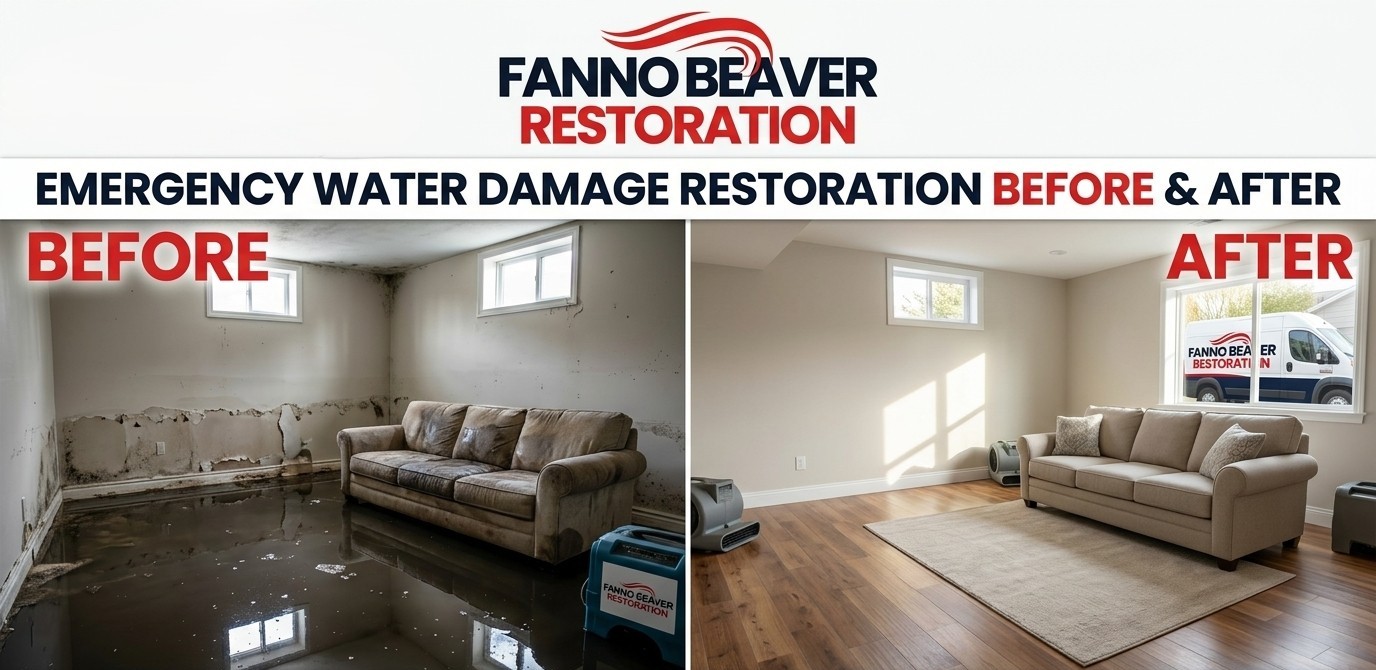
Flooded South Beaverton Basement — 800 Sq Ft
Standing water from a failed sump pump during a December storm event, covering 800 square feet of finished basement in South Beaverton, fully extracted and dried to IICRC-certified moisture levels within 72 hours, preventing an estimated $35,000 in secondary mold and structural damage that would have developed within the following two weeks.
Category 3 Sewage Backup — Central Beaverton
A main line sewage backup contaminated the lower level with biohazardous black water. Full containment, complete removal of all affected porous materials, AMRT-certified antimicrobial treatment, and complete reconstruction coordination returned the space to habitable condition with zero remaining odor or contamination.
Burst Pipe Winter Damage — Sexton Mountain Home
A frozen and burst supply line released water into three rooms over an estimated 6-hour period before discovery. Thermal imaging revealed moisture in wall cavities across 4 rooms not visible to the eye. Full structural drying over 5 days achieved certified-dry readings throughout, saving all wall framing and eliminating mold risk.
Water Heater Failure — Vose Neighborhood Apartment Building
A catastrophic water heater tank rupture affected 3 units and a common hallway. Complete extraction, structural drying, and documented moisture certification was completed across all affected units with direct insurance coordination that resolved the claim without disputes.
Fanno Creek Corridor Basement Flooding — Five Oaks Property
A Five Oaks property near the Fanno Creek Greenway experienced recurring seasonal basement flooding from groundwater table rise. Emergency extraction, full structural drying, and comprehensive drainage assessment documentation ended a 3-year cycle of seasonal damage.
Emergency Water Damage Restoration Equipment & Certified Methods Used in Every Beaverton, OR Project
Professional-grade, calibrated industrial restoration systems operated by certified technicians — not consumer equipment operated by general laborers
The difference between professional emergency water damage restoration and consumer-grade DIY response is not just effort — it is equipment capacity, calibration, and the certified expertise to deploy it correctly. Fanno Beaver Restoration uses commercial restoration-grade equipment maintained and calibrated to manufacturer specifications and operated exclusively by IICRC-certified technicians following IICRC S500 Standard and Reference Guide protocols on every emergency water damage restoration project in Beaverton, Oregon. Our equipment inventory carried on every service van represents an investment of over $150,000 in professional restoration technology — because proper emergency restoration requires proper tools, not borrowed fans and hardware store dehumidifiers.
Truck-Mounted Extraction Systems
Producing 200+ inches of water lift and 300+ CFM airflow for maximum-speed standing water removal from basements, ground floors, and large affected areas throughout Beaverton residential and commercial properties.
Portable High-Efficiency Extraction Units
For upper floors, interior rooms, tight crawl spaces, and areas where truck-mount reach is limited — ensuring complete extraction capability in every Beaverton property configuration.
Specialty Extraction Tools
Dedicated carpet wand extractors, hardwood floor extraction heads, and sub-surface suction tools designed to pull water from deep within carpet, padding, and flooring systems without causing additional surface damage.
Commercial LGR Dehumidifiers
Industrial units removing 150–250 pints of moisture per day under AHAM conditions — dramatically outperforming consumer dehumidifiers that remove 30–70 pints per day at best. The difference between a 3-day and a 10-day drying timeline.
High-Velocity Axial & Centrifugal Air Movers
Positioned in calculated airflow patterns by ASD-certified technicians to maximize evaporation from wet structural surfaces and direct moisture-laden air toward dehumidifier intakes efficiently.
FLIR Thermal Imaging Cameras
Detect temperature differentials indicating hidden moisture migration inside wall cavities, above ceilings, and under flooring that moisture meters cannot access without physical penetration — essential for mapping the full extent of structural saturation in Beaverton properties.
Calibrated Pin & Pinless Moisture Meters
Precise measurement of moisture content in wood, drywall, concrete, and other structural materials against established IICRC dry standard benchmarks at every monitored point throughout the drying cycle.
Sling Psychrometers & Digital Hygrometers
Ambient condition monitoring to calculate evaporation potential, track drying progress against psychrometric targets, and document the scientific conditions of the drying environment daily throughout every Beaverton restoration project.
EPA-Registered Antimicrobial Treatment Systems
Hospital-grade antimicrobial solutions applied via electrostatic sprayers for complete surface coverage on all water-contacted materials after drying is confirmed — essential for comprehensive mold prevention.
HEPA-Filtered Air Scrubbers
Continuously filter airborne particulate, mold spores, and microbial contaminants from the work environment during all Category 2, Category 3, and mold-involved projects.
Structural Drying Wall Panels & Floor Mat Systems
Directed drying systems that inject conditioned air directly into wall cavities and under flooring systems to dry structural assemblies from the inside without requiring complete demolition access in appropriate cases.
Emergency Mitigation vs. Full Restoration: Which Emergency Water Damage Response Does Your Beaverton Property Need?
Understanding emergency stabilization, water mitigation, structural drying, and complete water damage restoration — and when each is appropriate for Beaverton, OR properties
Emergency water mitigation is the immediate response phase — stopping the water source, extracting standing water, and beginning structural drying to prevent ongoing damage progression. Full emergency water damage restoration encompasses the complete scope: mitigation plus certified structural drying to IICRC dry standards, antimicrobial treatment, material removal where required, mold prevention, content handling, insurance documentation, and coordination of all necessary reconstruction repairs. Understanding the distinction between these two phases — and when partial mitigation alone is insufficient for your specific Beaverton property and damage scenario — helps homeowners and property managers make faster, better-informed decisions during the high-stress moments of a water emergency.
| Service Phase | What It Includes | Best For | Key Limitations |
|---|---|---|---|
| Emergency Stabilization Only | Water source control, basic extraction of standing water, temporary containment | Active flooding situations where stopping the water source and removing standing water is the immediate priority | Does not address structural moisture, hidden damage, mold risk, material removal, or insurance documentation |
| Water Mitigation | Emergency stabilization plus structural extraction, equipment deployment, and drying initiation | Category 1 clean water events with limited structural spread caught and responded to within the first few hours | May not include certified drying logs, antimicrobial treatment, content handling, or reconstruction scoping |
| Full Emergency Water Damage Restoration ✔ Recommended | Complete mitigation plus certified structural drying, IICRC documentation, antimicrobial treatment, material removal, mold prevention, content inventory, insurance coordination, and reconstruction scoping | All Category 2 and Category 3 events; any event with structural penetration; any insurance claim; any property where health, safety, or resale is a concern | Requires the greatest investment of time and resources — and is precisely what most Beaverton water damage events actually require |
When Full Emergency Water Damage Restoration Is the Only Appropriate Response:
Category 2 or Category 3 water source — any gray water or sewage contamination event requires full antimicrobial protocols and selective material removal that partial mitigation cannot deliver
Moisture detected inside wall cavities, above ceilings, or under flooring by thermal imaging or moisture metering — hidden structural moisture cannot be resolved by surface drying alone
Any musty odor, visible discoloration, or suspected mold within 24–48 hours of the water event — active mold colonization requires AMRT-certified intervention beyond standard drying
Water event has been present for more than 12–24 hours before professional response — extended exposure dramatically increases structural saturation depth and mold establishment risk in Beaverton's humid climate
Insurance claim is involved — insurance adjusters require IICRC-certified psychrometric documentation, moisture logs, and written damage assessments that only a full restoration process produces
Property is occupied by vulnerable household members — children, elderly residents, and immunocompromised individuals cannot safely remain in a property with incomplete water damage restoration and emerging mold risk
Property must satisfy buyers, lenders, or home inspectors — only certified complete restoration with documented moisture readings provides the proof of remediation that real estate transactions require
Previous water damage history at the property — properties with prior water events require thorough assessment and full restoration to prevent compounding damage to structural assemblies already weakened by prior moisture exposure
How Much Does Emergency Water Damage Restoration Cost in Beaverton, OR?
From emergency extraction cost per square foot to complete Category 3 sewage restoration — transparent pricing ranges and the honest cost factors that determine your specific project investment
Understanding the cost of emergency water damage restoration before committing to a contractor is completely reasonable — even in a crisis situation. Fanno Beaver Restoration believes in complete pricing transparency and provides every Beaverton property owner with a clear, written, itemized estimate before any restoration work begins. We use an internal damage assessment protocol that factors in your property's specific affected square footage, water damage category, structural saturation class, material types, equipment requirements, and reconstruction scope to produce an honest estimate that reflects actual project requirements — not a lowball number designed to get us in the door before revealing additional costs. The ranges below represent typical Beaverton-area project costs based on our 10-year project history in Washington County — your specific project will be estimated precisely during your free on-site assessment.
Primary Cost Drivers — Beaverton, OR Water Damage Restoration
Total Affected Square Footage
Both the visible impact zone and the hidden structural spread revealed by thermal imaging and moisture metering determine equipment quantity, labor hours, and drying timeline.
Water Damage Category (1, 2, or 3)
Category 3 sewage events require significantly more labor, materials, PPE, disposal, antimicrobial treatment, and material removal than Category 1 clean water events — the category is the single largest cost variable.
Structural Saturation Class (1–4)
Class 3 and Class 4 events requiring specialty drying protocols, wall cavity access, and flooring system drying add equipment quantity, duration, and labor cost beyond standard Class 1 and 2 projects.
Time Between Event and Professional Response
Water events responded to within the first 1–2 hours consistently require less equipment, shorter drying cycles, and less material removal than events that progressed for 12–24+ hours — fast calling saves real money.
Equipment Deployment Duration
The number of days required to achieve certified-dry readings across all structural points depends on damage class, material types, ambient conditions, and building construction — typically 3 to 7 days for most Beaverton residential projects.
Mold Remediation Scope
If active mold colonization is discovered during assessment, AMRT-certified mold remediation adds material removal, air scrubbing, antimicrobial treatment, and extended documentation beyond standard water damage restoration scope.
Reconstruction Requirements
The cost of replacing removed drywall, flooring, insulation, cabinetry, and trim is separate from mitigation and restoration costs and depends on the material types, square footage, and finish specifications of your specific Beaverton property.
Typical Restoration Cost Ranges — Beaverton, OR
| Service / Scope | Typical Cost Range (Beaverton, OR) |
|---|---|
| Emergency water extraction — per square foot | ~$3.75 – $7.50 per sq. ft. |
| Commercial dehumidifier rental — per unit per day | ~$75 – $150 per unit/day |
| Commercial air mover — per unit per day | ~$25 – $50 per unit/day |
| Category 1 limited-scope water damage restoration | ~$1,500 – $4,500 |
| Category 1 full-room to full-floor restoration | ~$4,000 – $9,000 |
| Category 2 gray water full restoration | ~$4,500 – $11,000 |
| Category 3 sewage / black water full restoration | ~$8,000 – $20,000+ |
| Basement flood cleanup and full restoration | ~$3,000 – $12,000+ |
| Mold remediation (discovered during restoration) | ~$1,500 – $8,000+ depending on scope |
| Reconstruction (drywall, flooring, cabinetry) | Separately estimated per scope of work |
All cost ranges are estimates based on typical Beaverton-area project experience. Your specific project cost depends on affected area, category, class, structural impact, and reconstruction scope. Fanno Beaver Restoration provides a free written estimate before any work begins — contact us at +1 (971) 462-1200 or fannobeaverrestoration@gmail.com
Insurance Cost Consideration
Most standard homeowner's insurance policies in Oregon cover sudden and accidental water damage events. Fanno Beaver Restoration works directly with all major insurance carriers to ensure your covered damage is fully documented and advocated for throughout the claims process. We have extensive experience helping Beaverton homeowners maximize their covered restoration scope and navigate the claims process without disputes.
Who Needs Full Emergency Water Damage Restoration vs. Basic Cleanup in Beaverton, OR?
When surface cleaning is dangerously inadequate — and only certified professional emergency restoration protects your property, your health, and your financial interests
Fanno Beaver Restoration recommends full certified emergency water damage restoration — not surface cleanup, household fan drying, or partial mitigation — when the nature of the water event, the structural condition of the property, the health and safety profile of the occupants, or the insurance and resale implications of the damage make anything less than complete professional restoration an unacceptable risk. In Beaverton's climate, where incomplete water damage response almost inevitably leads to mold colonization within days and structural damage within weeks, the cost of inadequate initial response consistently exceeds the cost of proper professional restoration by a factor of 3 to 10. Understanding who needs full restoration — and why — helps Beaverton property owners make the right call immediately rather than discovering the consequences of inadequate response weeks later.
Full Emergency Water Damage Restoration Is Required When:
The water source was sewage, toilet overflow, outdoor floodwater, or any Category 3 black water — biohazardous contamination cannot be safely managed without full containment, material removal, and AMRT-certified sanitization protocols
Water has been present for more than 12 hours before professional response — in Beaverton's humid Pacific Northwest climate, 12+ hours of untreated water intrusion is sufficient for mold colonization to begin in wall cavities and under flooring
Thermal imaging or moisture metering reveals moisture inside wall cavities, above ceiling assemblies, or beneath flooring — hidden structural moisture cannot be resolved by surface extraction and fans
The property has experienced previous water damage events — structural assemblies weakened and potentially already harboring dormant mold from prior water events require thorough professional assessment and complete restoration
Any occupant of the property is a child, elderly individual, or person with respiratory conditions, allergies, or immune system compromise — these populations are at significantly elevated risk from mold spores and microbial contamination
Your insurance carrier requires documented professional restoration — insurance claims require IICRC-certified psychrometric drying logs, thermal imaging documentation, written damage assessments, and certified dry completion records
The property must satisfy a buyer, mortgage lender, home inspector, or property management company — only certified complete restoration with documented moisture readings provides the proof of remediation that real estate transactions require
The property is a rental unit occupied by tenants — Oregon landlord-tenant law requires landlords to maintain habitable conditions; water damage that creates mold risk or structural hazard creates legal liability that only certified professional restoration can properly document and mitigate
The water event affected multiple rooms, multiple floors, or includes basement and crawl space areas — multi-zone water events involve structural spread and cross-system moisture migration that requires professional assessment and multi-zone equipment deployment
Benefits of Professional Emergency Water Damage Restoration in Beaverton, OR — Far More Than Cleanup
Certified professional restoration protects your property structure, your family's health, your insurance claim, and your long-term financial investment in your Beaverton home or business
Professional emergency water damage restoration is not simply a more thorough version of what you could do yourself with better equipment. It is a certified, documented, scientifically controlled process that delivers outcomes fundamentally unavailable through DIY response or uncertified cleanup services — outcomes that directly protect your property's structural integrity, your family's health, your insurance claim's completeness, and your property's long-term market value. For Beaverton homeowners and business owners facing the immediate stress of a water emergency, understanding the full spectrum of benefits that certified professional restoration delivers helps clarify why the investment in professional response is not a luxury — it is the single best financial and safety decision available.
Dramatically Limits Total Damage Cost
Certified professional response within the first 1–2 hours consistently limits total damage scope and total restoration cost by preventing the compounding progression from surface saturation to structural saturation to mold colonization — the difference between a $3,500 restoration and a $25,000 reconstruction.
Prevents Mold Colonization Before It Begins
AMRT-certified antimicrobial treatment combined with certified structural drying that achieves IICRC-standard moisture levels eliminates the conditions for mold growth rather than simply slowing it, protecting your Beaverton family from the respiratory, allergic, and systemic health effects of toxic mold exposure.
Produces Insurance-Compliant Documentation
IICRC-certified psychrometric drying logs, thermal imaging records, complete photo documentation, and written damage assessments satisfy insurance adjuster requirements and prevent claim denials, underpayments, and disputes that unqualified cleanup attempts routinely create.
Returns Property to Safe Conditions 3–5x Faster
Commercial drying equipment operating under certified structural drying protocols achieves certified-dry structural conditions in 3–7 days for most Beaverton residential projects. Consumer-grade equipment attempting the same structural drying frequently fails to achieve certified-dry conditions at all, leaving hidden moisture that continues causing damage for months.
Protects Beaverton Property Resale Value
Certified restoration documentation provides legally supportable proof of professional remediation that satisfies buyers, real estate attorneys, mortgage lenders, and home inspectors. Undocumented or improperly performed restoration creates disclosure liability and inspection failures that reduce property value and kill real estate transactions.
Protects Your Family from Serious Health Risks
Proper Category 2 and Category 3 water handling with appropriate PPE, containment, and HEPA air filtration protects your family from pathogens present in gray and black water events. Proper structural drying and antimicrobial treatment prevents the airborne mold spore exposure that develops from incomplete restoration in Beaverton's humid climate.
Eliminates Legal & Liability Risk for Landlords
Certified professional restoration with complete documentation demonstrates that a landlord or property manager met their duty of care obligation to tenants under Oregon law, protecting against tenant claims of habitability failure, mold injury, and property damage.
Complete Peace of Mind Through Documented Process
Knowing that certified professionals with calibrated equipment and IICRC credentials have restored your Beaverton property to documented, measured, certified-dry conditions eliminates the anxiety of wondering whether hidden moisture will become tomorrow's mold problem — because the documentation proves it will not.
Safety Alert: Do Not Attempt DIY Emergency Water Damage Restoration in Beaverton, OR
Flooded properties are active safety hazards — and inadequate DIY response creates hidden consequences that cost 3 to 10 times more than immediate professional restoration
When water flooding enters your Beaverton home or business, the instinct to grab mops, shop vacs, and household fans and begin immediate cleanup is completely understandable — and in most water damage situations, it is a dangerous mistake that compounds your losses rather than limiting them. Flooded properties in Beaverton present multiple simultaneous safety hazards that are invisible to untrained eyes: live electrical hazards from water contacting outlets, wiring, panels, and appliances; structural instability from water-weakened flooring, subfloor assemblies, and wall framing; biohazardous contamination from sewage and gray water events that cannot be safely handled without proper PPE and protocols; and toxic mold conditions that develop from incomplete drying inside wall cavities and under flooring within 24 to 48 hours of a water event in Beaverton's naturally humid Pacific Northwest climate. The financial consequences of DIY water damage response frequently exceed the cost of professional restoration by 3 to 10 times. Fanno Beaver Restoration's certified crews use proper respiratory protection, electrical safety protocols, containment systems, biohazard handling procedures, and IICRC-standard structural drying methods on every Beaverton emergency restoration project.
⚡ Electrical Hazard
NEVER enter a flooded space where water may have contacted outlets, switches, appliances, wiring, or electrical panels. If you cannot safely reach your main electrical panel without entering the flooded area, evacuate the property and call both your utility provider and Fanno Beaver Restoration at +1 (971) 462-1200 immediately.
🦠 Biohazard Warning
Never attempt to clean, mop, or handle sewage-contaminated water, toilet overflow, or outdoor floodwater without full biohazard PPE including waterproof gloves, eye protection, N95 or better respiratory protection, and waterproof protective coveralls — Category 3 black water contains bacteria, viruses, and pathogens that cause serious illness through skin contact, ingestion, and inhalation.
🏚️ Structural Hazard
Do not walk on flooring over a flooded basement or crawl space without verifying structural integrity — water-saturated subfloor assemblies can fail suddenly under foot traffic, creating a fall-through hazard. Water-weakened structural framing in walls and ceilings creates collapse risk in severe water events.
🌬️ Drying Inadequacy
Do not use household fans, window air conditioning units, or consumer dehumidifiers as a substitute for professional structural drying — consumer equipment cannot achieve the air velocity, dehumidification capacity, or psychrometric conditions required to dry structural assemblies in Beaverton's humid climate.
⏰ Time Criticality
Do not wait until morning, until the weekend ends, or until your insurance company responds before calling for emergency restoration — in Beaverton's climate, every hour of delay after a water event increases structural saturation depth, mold establishment risk, and total restoration cost. The 2:00 AM call saves far more than it costs.
🧴 Bleach Ineffectiveness
Applying bleach to water-damaged materials is not mold prevention and is not antimicrobial treatment. Bleach applied to porous materials like drywall, wood framing, and flooring evaporates from the surface while leaving the subsurface moisture and organic material that supports mold growth completely untreated.
Emergency Water Damage Restoration FAQs for Beaverton, OR Homeowners, Landlords & Business Owners
Honest, complete answers about emergency response time, restoration cost, insurance coverage, mold risk, the restoration process, and what to do first when water damage strikes your Beaverton property
We dispatch immediately upon receiving your call to +1 (971) 462-1200 — 24 hours a day, 7 days a week, 365 days a year including holidays, weekends, and during active storm events. Our team operates from our base at 10300 SW Nimbus Ave in Tigard, OR, with 5 fully equipped service vans ready for deployment throughout Beaverton and all surrounding Washington County communities at any time. Response time to most Beaverton neighborhoods is typically 30 to 60 minutes or less from dispatch — though we provide an accurate estimated arrival time when you call.
Emergency water damage restoration costs in Beaverton range widely based on the water damage category, affected square footage, structural saturation class, and reconstruction requirements. Category 1 clean water events with limited spread may cost between $1,500 and $4,500 for complete professional restoration. Category 2 gray water events typically range from $4,500 to $11,000. Category 3 sewage or major floodwater events requiring full biohazard protocols, material removal, and reconstruction coordination typically range from $8,000 to $20,000 or more. Fanno Beaver Restoration provides a complete written estimate before any work begins — and most projects that involve sudden and accidental water damage are covered in whole or in significant part by standard homeowner's insurance policies.
Most standard homeowner's insurance policies in Oregon cover sudden and accidental water damage — including burst pipe events, appliance failures, and certain roof leak situations — but typically exclude gradual leaks, lack of maintenance, and flooding from outdoor surface water sources without a separate flood insurance policy. Fanno Beaver Restoration works directly with all major insurance carriers and has extensive experience navigating Oregon homeowner's insurance claims. We provide complete IICRC-certified documentation, communicate directly with your adjuster, submit all required damage documentation, and advocate throughout the claims process to help ensure your covered damage receives the full restoration scope it deserves.
In Beaverton's naturally humid Pacific Northwest climate, mold colonization of wet organic materials — drywall paper, wood framing, flooring underlayment, carpet backing, and insulation — can begin within 24 to 48 hours of a water intrusion event under normal indoor temperature conditions. During Beaverton's warmer months, when indoor temperatures are higher, mold colonization can begin even faster. This is why emergency water damage restoration must begin within hours of a water event — not days — to prevent mold from becoming a secondary remediation project that adds thousands of dollars to your total restoration cost.
Consumer fans and hardware store dehumidifiers are designed for comfort and general humidity control — they are not engineered for structural drying of water-saturated building assemblies. A standard consumer dehumidifier removes 30–70 pints of moisture per day in ideal conditions. Our commercial LGR dehumidifiers remove 150–250 pints per day under actual damaged-structure conditions. More importantly, consumer equipment cannot penetrate into wall cavities, under flooring, or into subfloor assemblies where structural moisture exists after a water event — so even if the surface appears to be drying, hidden moisture continues saturating structural framing and supporting mold growth. The result of DIY drying attempts is almost always a surface that appears dry while structural moisture continues causing damage — creating far greater costs than immediate professional restoration would have required.
Call +1 (971) 462-1200 immediately — we will dispatch a crew and guide you through safe first steps while we are en route. If it is safe to do so without entering flooded areas, shut off the water source at the nearest shutoff valve. Do not enter any area where water may have contacted electrical systems without verifying power is off. Do not attempt to clean up sewage or gray water contamination without professional guidance. Document visible damage with your phone camera if it is safe to do so. Do not move furniture or belongings over saturated flooring if there is any concern about subfloor integrity. The most important first step is always calling for certified professional emergency response immediately — every hour matters in Beaverton's humid climate.
Yes — comprehensive insurance claim support is included in every Fanno Beaver Restoration emergency water damage restoration project. We provide complete photo documentation from initial assessment through project completion, IICRC-certified psychrometric drying logs that satisfy adjuster documentation requirements, written damage assessments identifying all affected materials and required repairs, direct communication with your insurance adjuster throughout the claims process, and supplement requests when additional covered damage is identified during restoration. Our documentation has been developed specifically to support Oregon homeowner's insurance claims and to prevent the underpayment disputes and claim denials that result from inadequate documentation by uncertified restoration contractors.
Yes. While Beaverton, OR is our primary service market, Fanno Beaver Restoration provides emergency water damage restoration throughout Washington County and the Greater Portland Metro area — including Aloha, Cedar Hills, Cedar Mill, Durham, Garden Home-Whitford, Hillsboro, King City, Lake Oswego, Metzger, Oak Hills, Portland, Raleigh Hills, Rockcreek, Sherwood, Tigard, Tualatin, West Haven-Sylvan, West Haven, and West Slope.
Our Beaverton Emergency Water Damage Restoration Guarantee — Certified Results, Complete Documentation, and Our Unwavering Commitment to Your Recovery
Your restored property — backed by IICRC-certified professionals, documented scientific drying results, complete insurance support, and Fanno Beaver Restoration's 10-year commitment to Beaverton
Fanno Beaver Restoration stands behind every emergency water damage restoration project in Beaverton, OR with IICRC-certified workmanship, complete psychrometric drying documentation, EPA-registered antimicrobial treatment, and our team's personal commitment to being with you from the moment you make your emergency call to the moment you walk through your fully restored property and receive your complete project documentation package. When Beaverton homeowners and business owners invest in professional emergency water damage restoration with Fanno Beaver Restoration, their investment goes into a certified, documented, scientifically verified restoration process — not a surface cleanup operation that leaves hidden moisture, unaddressed mold risk, incomplete insurance documentation, and the compounding consequences of inadequate initial response to develop into far greater problems. We do not consider a project complete until moisture readings at every monitored structural point reach IICRC-certified dry standards, every affected surface has received antimicrobial treatment, every documentation requirement for your insurance claim is satisfied, and you have reviewed, understand, and are confident in your complete project documentation.
Since 2015, homeowners and property owners across all of Beaverton — from families in historic neighborhoods near the Belle Ainsworth Jenkins Estate and Beaverton Historical Society to modern communities surrounding Nike World Headquarters, residents of Sexton Mountain and Five Oaks facing seasonal Fanno Creek corridor flooding, small business owners near Cedar Hills Crossing and Progress Ridge TownSquare, and landlords managing rental portfolios throughout South Beaverton, West Slope, and Central Beaverton — have trusted Fanno Beaver Restoration to answer their emergency calls immediately, respond with the right team and equipment, restore their properties completely and professionally, and document every step of the process so their insurance claims are settled, their families are safe, and their properties are fully protected from the long-term consequences of water damage.
Explore Our Full Restoration Service Portfolio:
Complete Service Area Coverage:
Monday – Sunday: Open 24 Hours | 00:00 – 23:59
Emergency Services: Available 24/7/365 — Including All Holidays & Severe Weather Events
Fanno Beaver Restoration — Beaverton's Certified Emergency Water Damage Restoration Team
Serving Beaverton, Washington County & the Tualatin Valley Since 2015
WRT · ASD · AMRT · CDS · FSRT Certified | Award-Recognized Regional Excellence
Get Emergency Restoration Services Beaverton OR Now
Need an emergency restoration company in Beaverton OR? Our 30 skilled professionals are standing by 24/7. Whether you need emergency water damage restoration, mold remediation, basement flood cleanup, or fire damage restoration in Beaverton OR — we're always ready to help.
Contact Fanno Beaver Restoration
Beaverton, OR 97223
Washington County
24/7 Emergency Service Always Available